Old Fortress of Corfu, Venetian fortress in Corfu, Greece
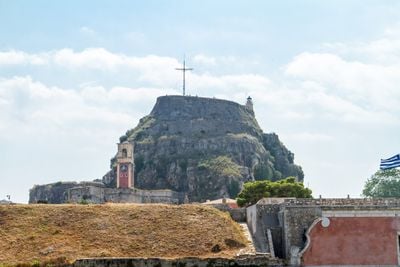
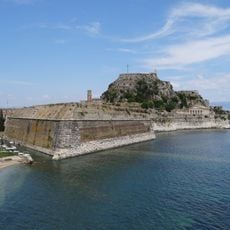
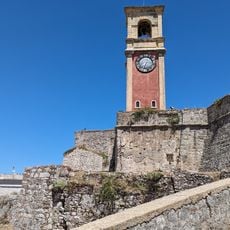
The Old Fortress of Corfu occupies a rocky promontory with two peaks at the eastern edge of the town, separated from the mainland by the Contrafossa, a sea channel linking the Gulf of Kerkyra and Garitsa Bay. A massive pale stone wall runs along the waterline, with a square clock tower on the left and a low rectangular building with a tiled roof and a row of windows on the right. A cross stands on the highest point, near a small round turret.
The site was first fortified around the 6th century AD, when survivors of the Ostrogothic destruction of ancient Corcyra settled on the peninsula. The Venetians began replacing the Byzantine walls in the early 15th century; after the Ottoman siege of 1537 their engineers Savorgnan and Martinengo built new bastions between 1545 and 1555 and cut the Contrafossa moat, turning the citadel into an island. The fortress repelled the Ottoman sieges of 1537, 1571 and 1716, the last under Count Johann Matthias von der Schulenburg.
The fortress gave Corfu its Western name: the twin peaks of the citadel were called "Coryphe" in Greek, and the town became known abroad as Corfu. The sea channel the Venetians cut to isolate the promontory is still called Contrafossa by locals, and the entrance from Spianada square is crossed today by a permanent bridge where a drawbridge once stood.
You can reach the fortress by crossing an iron bridge where the original drawbridge once stood. Wear sturdy shoes as the paths are uneven and surfaces can become slippery, especially after rain.
The fortress's twin peaks gave Corfu its Western name: "Coryphe" in Greek means peak, and the city was called after them. The higher western hill, closer to town, was the Venetians' Castel a Terra, while the eastern one by the sea was Castel a Mare, used for a time as a powder magazine.
The community of curious travelers
AroundUs brings together thousands of curated places, local tips, and hidden gems, enriched daily by 93,246 contributors worldwide.