Temple of Artemis, Ancient Greek temple in Garitsa, Greece
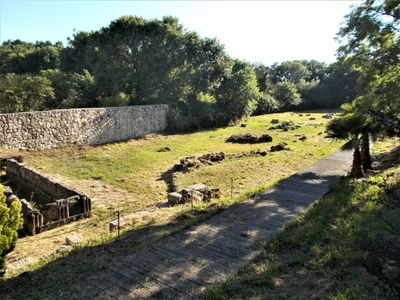
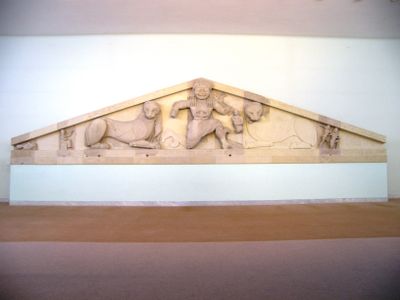
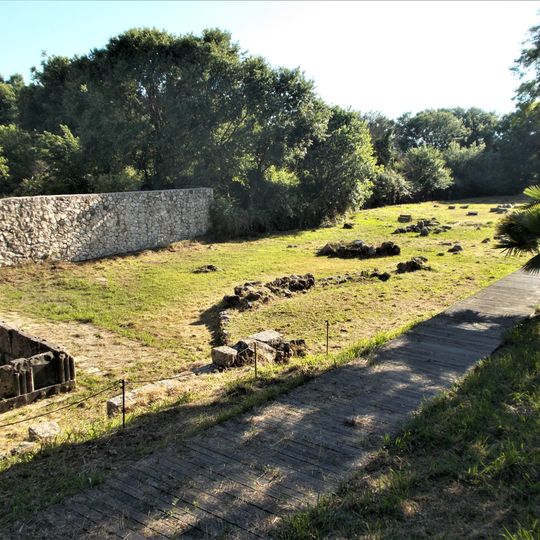
The Temple of Artemis at Garitsa is a peripteral Doric temple of porous stone, 23.46 m wide and 49 m long, oriented east. Today only scattered foundation blocks and wall courses lie in the grass beside the Saint Theodore monastery; the western pediment with Medusa and two panthers is kept in the Archaeological Museum of Corfu.
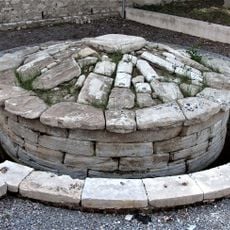
Built around 580 BC in the ancient city of Korkyra, the temple was one of the first Doric temples made entirely of stone. Its rectangular altar, 2.7 m wide and 25 m long, stood in front of the building; only 8 m of its northern section survive, as the Saint Theodore monastery was later built over the southern part. French soldiers under General Donzelot found the ruins during the Napoleonic Wars while digging trenches, and excavations continued from 1911.
The western pediment, about 585 BC, shows Medusa running with bent legs, flanked by two panthers and by smaller figures of her children Pegasus and Chrysaor; corner figures lie dead. It marks the shift from purely apotropaic images to narrative scenes. Ten of 21 relief slabs in porous stone were found between 1911 and 1914 by Wilhelm Dörpfeld at the Garitsa monastery; Gerhart Rodenwaldt's reconstruction is in the Archaeological Museum of Corfu.
The ruins lie on the grounds of the Saint Theodore monastery in Garitsa, about 700 m northwest of the Temple of Hera in Palaiopolis. Only foundations and loose blocks remain, so the western pediment itself is seen at the Archaeological Museum of Corfu. The monastery was built over the southern part of the altar, so the two are read together.
French troops uncovered the first foundations during the Napoleonic Wars, long before systematic excavations on Corfu began. The western pediment reliefs were later installed at the Archaeological Museum of Corfu, where they now form part of the permanent collection.
The community of curious travelers
AroundUs brings together thousands of curated places, local tips, and hidden gems, enriched daily by 92,814 contributors worldwide.