Tomb of Menecrates, Archaic cenotaph in Garitsa, Corfu, Greece
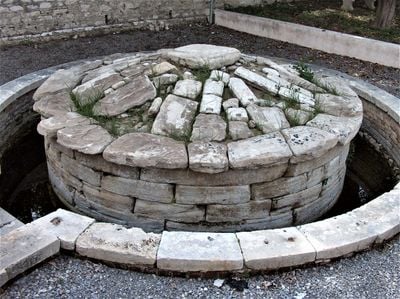
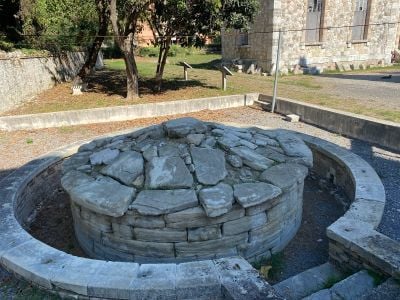
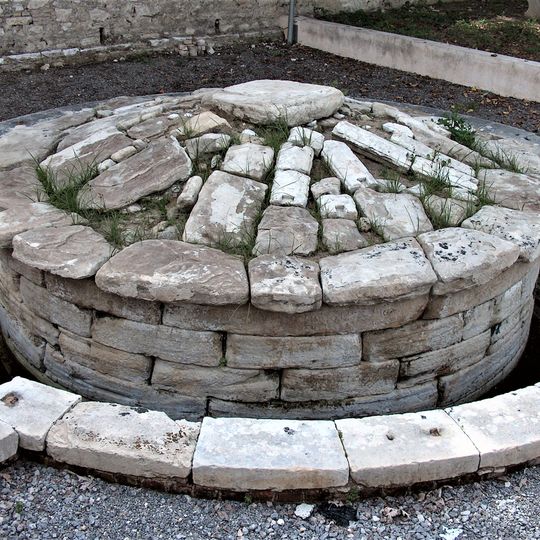
The Tomb of Menecrates is a cylindrical cenotaph of local limestone on Garitsa Hill, 1.4 m high and 4.7–4.9 m across. Its wall is built in isodomic masonry as five stacked horizontal courses of equal-thickness stones, closed by a conical roof of stones radiating from a central rectangular capstone. A low ring of flat slabs lies on the ground around the base.
The structure was built between 570 and 540 BC in ancient Korkyra during the early Archaic period. British forces uncovered it in 1843 while demolishing a Venetian fortress that had occupied the same hilltop.
The inscription on the monument is written in early Corinthian script and honors Menecrates for his role as an ambassador from the city. The text reveals how important such diplomatic missions were to the community.
The tomb sits on Garitsa Hill, where the nearby Archaeological Museum of Corfu displays the lion sculpture discovered during excavation. The location is easy to walk to and offers views over the city and harbor.
The inscription on the monument is one of the oldest surviving texts in Greece and was composed in dactylic hexameter, a form of poetic verse. The text also mentions Praximenes, the brother of Menecrates, providing rare glimpses into the family of this important figure.
The community of curious travelers
AroundUs brings together thousands of curated places, local tips, and hidden gems, enriched daily by 92,872 contributors worldwide.