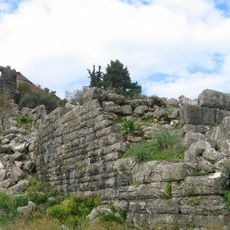
Thermos, Ancient Greek sanctuary in Thermo Municipality, Greece
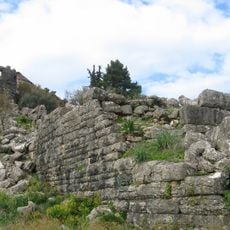
Thermos is an ancient Greek sanctuary in Thermo Municipality, Greece. Its Temple of Apollo, built about 630–610 BC, was surrounded by a peristyle of 15 wooden columns on each side and 5 at each end, later replaced by stone. The visible remains are low stone foundations and wall lines on a grassy slope, with the temple measuring about 38.2 by 12.1 metres.
Occupation at Thermos reaches the Late Helladic IIA period around 1500 BCE, with apsidal Megaron A and Middle Helladic pottery. Megaron B, a cult building with a vestibule, cella and opisthodomos, was built around 1000 BCE and destroyed around 850 BCE. The Doric Temple of Apollo was erected about 630–620 BCE over Megaron B. Philip V of Macedon sacked it in 218 and 206 BCE; it was rebuilt in the second century BCE and abandoned in Roman times.
Thermos was the regular meeting place of the Aetolian League, a loose tribal association rather than a group of city-states. The sanctuary's name survives in the nearby village of Thermo. The painted terracotta metopes, among the earliest known in Greece, show mythological scenes such as Procne and Philomela preparing Itys for the table.
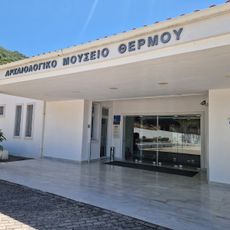
The ruins lie on a grassy slope with low stone foundations, wall lines and scattered blocks; no reconstructed paths or railings are visible. The ground is uneven and can be slippery when wet, so wear sturdy shoes. The finds, including the terracotta metopes, are kept in the museum at Thermos, not on the site.
The temple's wooden columns were replaced with stone only in the Hellenistic period, so the earliest structure had a wooden entablature painted terracotta. Its 90 cm terracotta metopes, among the oldest known, are argued to show the Doric frieze was decorative rather than structural from the start.
The community of curious travelers
AroundUs brings together thousands of curated places, local tips, and hidden gems, enriched daily by 92,967 contributors worldwide.