Antikythera wreck, Shipwreck off Antikythera, Attica, Greece
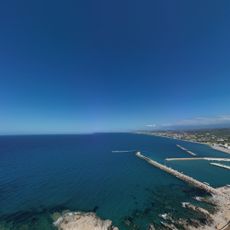
The Antikythera wreck is the remains of a Roman-era cargo ship that sank in the second quarter of the first century BC off Point Glyphadia, on the Greek island of Antikythera. Its elm hull planks, lead scupper pipes, hull sheeting and sounding leads of 6 and 14 kg lie on the seabed, which sponge divers first reached at 45 to 60 m depth in 1900.
The ship sank in the 1st century BC during a Mediterranean trade voyage and remained hidden on the seafloor for more than 2000 years. Its rediscovery by sponge divers in the early 1900s marked the beginning of modern underwater archaeology.
The cargo points to a ship carrying Greek art toward Italy: bronze and marble statues, gold jewellery, glassware and coins, now in the National Archaeological Museum of Athens. The 1902 recognition of a geared bronze fragment there led to the Antikythera mechanism, a calendrical calculating device built around 87 BC according to Derek de Solla Price's 1974 reading.
The wreck lies underwater and can only be visited with special permits and under strict supervision to protect its historical importance. Visits are limited to qualified professionals and specialized diving expeditions.
Aboard the vessel was found a mysterious ancient mechanism that functioned like a mechanical clock and continues to fascinate scientists today. This device reveals that ancient Greeks possessed a surprising understanding of complex technology.
The community of curious travelers
AroundUs brings together thousands of curated places, local tips, and hidden gems, enriched daily by 94,658 contributors worldwide.