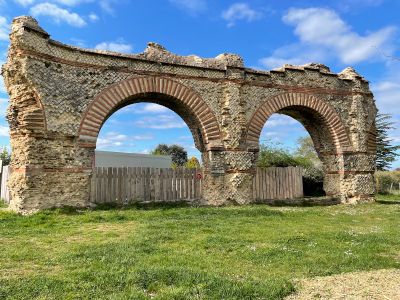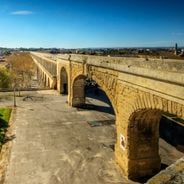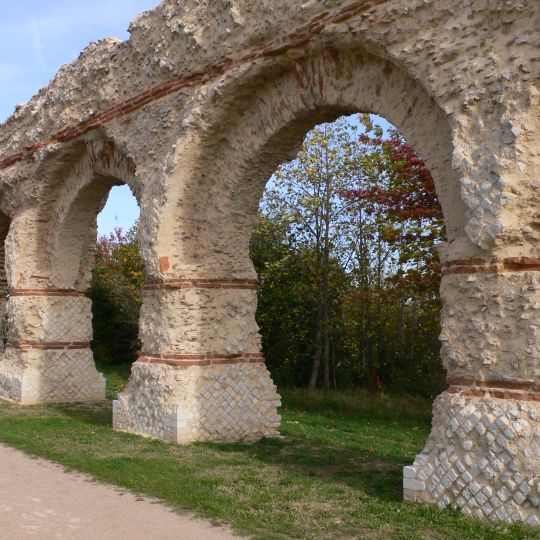
Aqueduct of the Gier, Roman aqueduct in Chaponost, France
The Aqueduct of the Gier is a Roman water channel that stretches from the Pilat massif down to Lyon through a series of stone arches and underground passages. The system crosses several communes and combines visible arched structures with hidden tunnels beneath the ground.
The Gier aqueduct was built in a single campaign, probably under Trajan: wood formwork in the foundations of the Beaunant siphon bridge was dated by dendrochronology to 110 AD, though completion under Hadrian is not excluded. It supplied Lugdunum until its abandonment; the Chagnon stone, found in 1887, records Hadrian's ban on ploughing or planting along its course.
The arches at Le Plat de l'Air in Chaponost are among the most visible remains of the aqueduct. The name Gier comes from the river whose springs on Mont Pilat supplied the water. The aqueduct was protected by an edict of Hadrian recorded on the Pierre de Chagnon, which banned ploughing, sowing or planting along its route.
The remains can be visited, with the best-preserved sections visible along the roadside in Chaponost. Guided tours arranged through the local Tourist Office help explain the different parts of the system and how to access the underground sections.
The aqueduct's slope averages just 0.1%, about one metre of fall per kilometre over its 85 km course. Engineer Paul de Gasparin surveyed the line in 1834 and calculated a daily flow of 24,000 m³, figures reused in Germain de Montauzan's 1908 thesis.
The community of curious travelers
AroundUs brings together thousands of curated places, local tips, and hidden gems, enriched daily by 93,357 contributors worldwide.