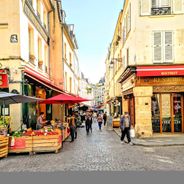
Rue Saint-Jean, Medieval street in Vieux Lyon district, France
Rue Saint-Jean is a stone-paved street running through the heart of old Lyon's medieval quarter, linking Place du Change with Place Saint-Jean. Its narrow lanes are lined with tall stone buildings standing closely together, creating a tight, enclosed urban structure.
Rue Saint-Jean was laid out in the late 3rd century, after the inhabitants of Fourvière, deprived of their water supply, came down to the Saône and built up the quarter that became Vieux Lyon. Its stretch from rue de la Bombarde to rue du Change was called rue du Palais, after the palais de Roanne, then grande rue in the 16th and 17th centuries; it led to the porte Froc, the gate into the cathedral group. In 1582 the king's treasurers of the bureau des finances rented a house here for their offices.
The street takes its name from the Cathedral of Saint-Jean, which it leads to. Its older names survive in the record: rue du Palais, referring to the palais de Roanne, then grande rue in the 16th and 17th centuries, and rue Porte-Froc for the stretch inside the episcopal close. Look for the painted "PHARMACIE St JEAN" shopfront facing the cathedral tower.
The best time to visit is early morning or outside peak hours, when the street is less crowded and you can see architectural details more clearly. Access is straightforward via the nearby Vieux Lyon - Cathédrale Saint-Jean metro station or through multiple bus lines serving the area.
The longest traboule in Vieux Lyon starts at No. 54 and crosses four buildings to reach No. 27 on Rue du Bœuf. Others lead from No. 7 to Quai Romain-Rolland, No. 10 to Rue de Gadagne, No. 27 to Rue des Trois Maries, No. 34 to Rue du Bœuf, No. 41 to Rue Mandelot and No. 40 to Place Neuve Saint-Jean. Many are open to visitors.
The community of curious travelers
AroundUs brings together thousands of curated places, local tips, and hidden gems, enriched daily by 93,051 contributors worldwide.