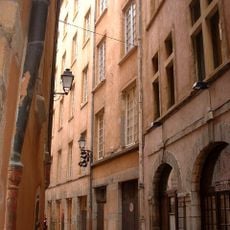
Rue du Bœuf, Medieval pedestrian street in Vieux Lyon, France
Rue du Bœuf is a 188-metre cobbled pedestrian street in Vieux Lyon, running north–south from Rue de Gadagne to the intersection of Rue du Chemin Neuf and Rue de la Bombarde. It is lined with 16th- and 17th-century houses; at the corner of Place Neuve Saint-Jean, a carved ox stands on a stone corbel above plaques reading "PLACE NEUVE SAINT JEAN" and "RUE DU BOEUF".
The street was laid out in the late 3rd century, when the inhabitants of Fourvière, deprived of water, descended to the Saône and built the quarter of Vieux-Lyon. It was long part of the Rue Tramassac and had its present name before 1586, after the carved ox placed at the corner of Place Neuve-Saint-Jean. In 1650 it was extended north to the Rue de Gadagne.
The name comes from the carved ox at the corner of Place Neuve-Saint-Jean, a pun on the name of doctor Louis Thorel, who was ennobled in 1597 and whose coat of arms bore a bull. The street was long called rue Tramassac, then rue de la Monnaie after Lyon's first mint opened here in the 15th century. Since 2017 it has held three Michelin-starred restaurants.
The street runs 188 metres north–south, linking Rue de Gadagne to the junction of Rue du Chemin Neuf, Rue de la Bombarde and Rue Tramassac. Its cobbles are pedestrian-only, but the Montée des Chazeaux, which crosses it near Rue de la Bombarde, climbs some 230 steps. Many traboules, including the long one at No. 27, are closed to the public.
The longest traboule in Vieux Lyon starts at No. 27 and crosses four houses to reach No. 54 on the Rue Saint-Jean. Most of the street's other traboules are closed to the public. At No. 14, Jean Croppet hid part of the cathedral treasure in his well in 1562.
The community of curious travelers
AroundUs brings together thousands of curated places, local tips, and hidden gems, enriched daily by 94,095 contributors worldwide.