Palais de justice historique de Lyon, Neoclassical courthouse in 5th arrondissement, France
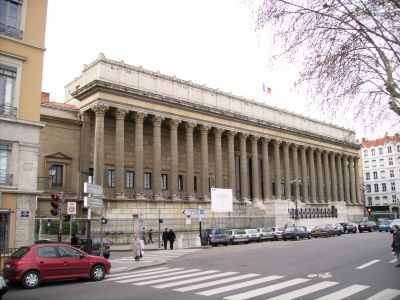
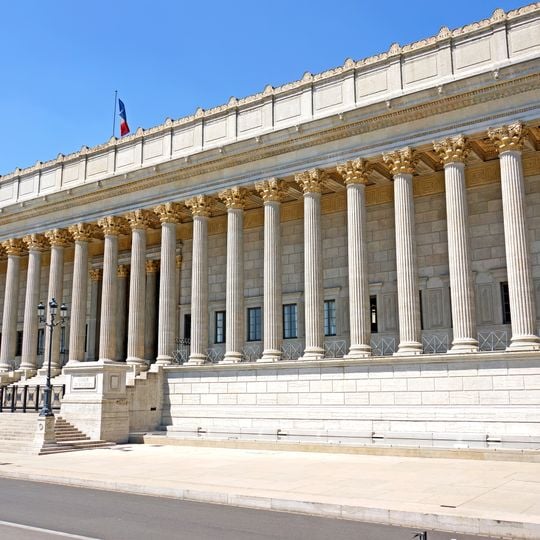
The Palais de Justice of Lyon is a courthouse featuring symmetrical design, large columns, and classical stone details arranged across its grand facade. Inside, the building preserves original 19th-century elements including carved wooden panels and marble staircases.
Construction began in 1835 and finished in 1847 under architect Louis-Pierre Baltard, who won the design competition in 1828. The building replaced the ruined Palais de Roanne on the same site, where Lyon's courthouses had stood since the 15th century. In 1995 court functions moved to La Part-Dieu, leaving the appeal court and the Rhône assizes here.
The building is nicknamed "Les vingt-quatre colonnes" after the twenty-four fluted columns of its facade. Its entrance hall, the salle des pas perdus, covers 625 m² under a 17-metre ceiling and holds two bas-reliefs: Legendre-Héral's Lyon welcoming the Arts, Commerce, Industry and Agriculture, and Bonnet's Justice punishing Crime.
The courthouse stands on Quai Romain-Rolland, on the right bank of the Saône in the 5th arrondissement, in the heart of Vieux Lyon. The 2008–2012 renovation made the building accessible to people with reduced mobility and reworked security. The cour d'appel and the cour d'assises du Rhône still sit here, so courtrooms may be closed to visitors during sessions.
The courthouse is nicknamed "Les vingt-quatre colonnes" after the row of columns along its facade. Its entrance hall, the salle des pas perdus, covers 625 m² under a 17-metre ceiling and holds two stone bas-reliefs: Legendre-Héral's Lyon welcoming the arts, commerce, industry and agriculture, and Bonnet's Justice punishing Crime.
The community of curious travelers
AroundUs brings together thousands of curated places, local tips, and hidden gems, enriched daily by 93,268 contributors worldwide.