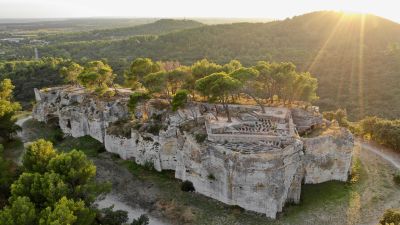
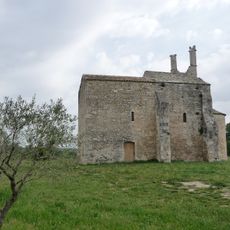
Abbey of Saint-Roman, Troglodyte monastery in Beaucaire, France.
The Abbey of Saint-Roman is a cave monastery cut into a pale beige limestone outcrop above the confluence of the Gardon and Rhône. Its main face is a broad, flat wall rising to a squared top, with a railed terrace on the upper left and a shadowed hollow beneath an overhang at lower right. A low wall of stacked grey, tan and pale yellow stones with a chevron pattern stands near rectangular trenches cut into the rock.
Monks established this site in the 10th century, expanding natural caves into a functioning monastery. The community abandoned the location in the 16th century, marking the end of monastic life there.
The abbey reveals how monks carved out their living spaces directly from limestone to create a functioning community. Walking through the cells and gathering halls shows the daily rhythm and practical arrangements of monastic life.
The site sits on a hillside above Beaucaire and is reachable on foot from the town center. Wearing comfortable shoes is important since the climb is steep and interior staircases can be narrow and slippery.
The abbey's name long evoked Romain de Condat, but recent research leans toward Roman, a martyr of Rome. Older Beaucairois historians compared the tombs in the chapel to late-antique catacombs. The site stayed known mainly to local circles until tourist promotion began in the early 21st century.
The community of curious travelers
AroundUs brings together thousands of curated places, local tips, and hidden gems, enriched daily by 92,883 contributors worldwide.