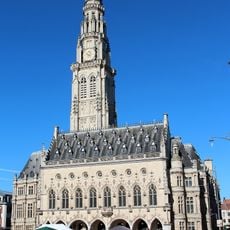
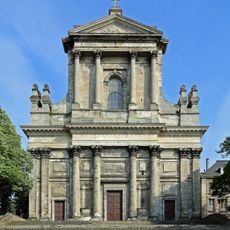
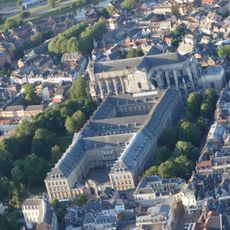
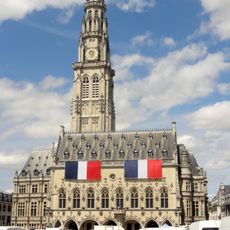
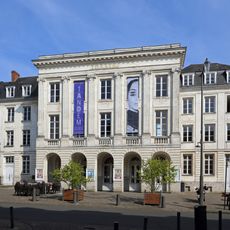
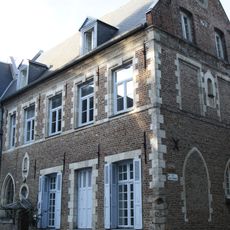
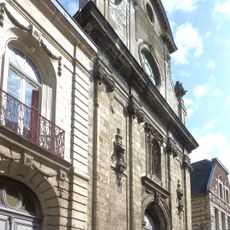
Musée des Beaux-Arts d'Arras, Art museum in Abbey of St. Vaast, Arras, France
The Musée des Beaux-Arts d'Arras occupies the former Abbey of St. Vaast. Its galleries include a long barrel-vaulted hall with a floor of black and white square tiles laid diagonally; arched openings with white pilasters and dark stone brackets line one wall, and small dark plaques are mounted on the white wall. Sculptures stand on white pedestals along the gallery, and a dark framed painting hangs on the right wall.
The museum was formed in 1795 from revolutionary seizures and moved into the former Abbey of St. Vaast in 1825. The abbey itself had been rebuilt in the 18th century. In 1915, during World War I, a fire destroyed many of the museum's paintings, including nine of the ten works by Jeanne-Élisabeth Chaudet; only her "Jeune fille pleurant sa colombe morte" survived.
The museum holds fourteen Mays, large canvases commissioned yearly from 1630 to 1707 by the Paris goldsmiths' guild for Notre-Dame Cathedral; the Louvre deposited them here in 1938, and seven are shown. The nine Muses painted by Giovanni Baglione in 1621–1623 for Ferdinando Gonzaga, Duke of Mantua, are also kept here, though the Melpomene is lost.
The museum occupies the former Abbey of St. Vaast, entered from the rue Paul Doumer side of the complex in central Arras. The galleries follow the old monastic rooms, so allow time to move between floors and wings. The Mays hang in a gallery with nine-metre ceilings; look up to see how the large canvases were scaled to the space.
Fourteen large canvases known as the Mays were commissioned by the Paris goldsmiths' guild for Notre-Dame between 1630 and 1707; the Louvre deposited fourteen at Arras in 1938, and seven are shown today. The set lacks Melpomène, the muse of tragedy, from Baglione's nine-muse series painted in 1621-1623 for the Duke of Mantua.
The community of curious travelers
AroundUs brings together thousands of curated places, local tips, and hidden gems, enriched daily by 93,030 contributors worldwide.