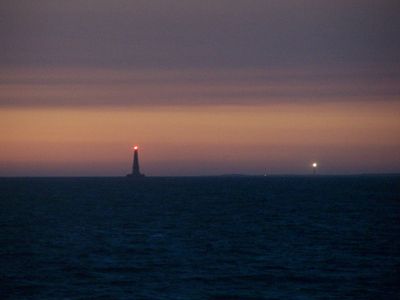
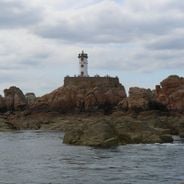
Cordouan Lighthouse, Lighthouse on the Cordouan plateau at the mouth of the Gironde estuary, Le Verdon-sur-Mer, France
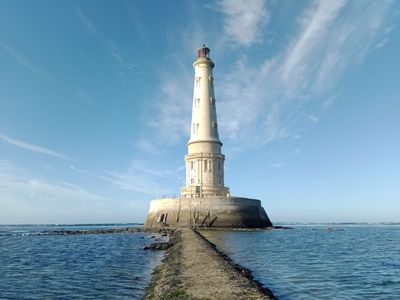
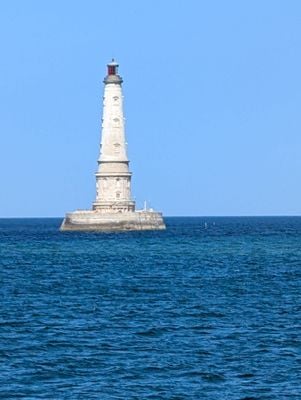
Cordouan Lighthouse is a tapering stone tower rising from a wide cylindrical lower section with vertical pilasters and recessed panels, ringed by a carved stone balustrade. Above it, a narrower round shaft with small rectangular windows ends in a dark, glass-paned lantern room. It stands on a flat stone base on the Cordouan plateau, about 7 km at sea near the mouth of the Gironde estuary, and reaches 67.5 m.
Construction began in 1584 and took nearly three decades to finish during the reign of Henri IV. In 1823, the tower served as a testing ground for new optical technology that was later adopted around the world.
The tower is nicknamed the "Versailles of the Sea", the "Lighthouse of Kings" and the "King of Lighthouses". Its ground floor holds a vestibule with four small cabinets, the first floor the so-called King's Apartment, and the second a domed circular chapel with Corinthian pilasters. Since 2010 the SMIDDEST association has handled visits and keeping.
Access is by boat from Royan or Le Verdon-sur-Mer, with crossings dependent on tide schedules and usually running between April and October. Those wishing to climb the tower should be prepared for several floors of stairs and wear sturdy shoes.
Louis de Foix died in 1602, before the lighthouse was finished; an 18th-century legend holds that he was buried in a secret spot inside it. The keepers' work continued long after: Cordouan is France's last inhabited lighthouse, staffed since 2012 by members of the SMIDDEST association rather than State keepers.
The community of curious travelers
AroundUs brings together thousands of curated places, local tips, and hidden gems, enriched daily by 93,784 contributors worldwide.