Bonnefontaine Abbey, Cistercian abbey in Blanchefosse-et-Bay, France
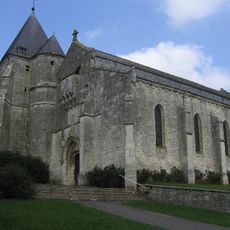
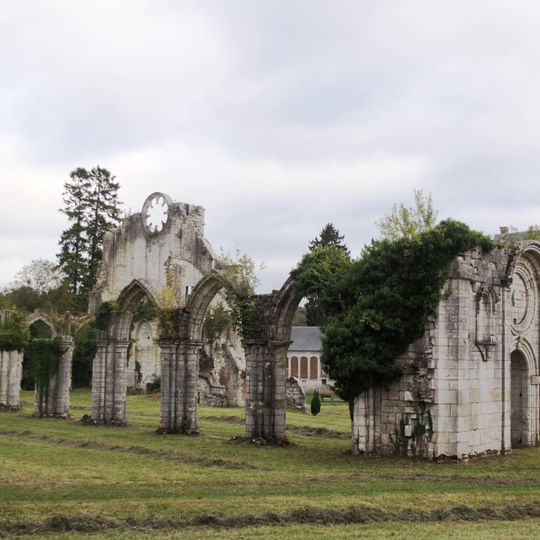
Bonnefontaine Abbey is a ruined Cistercian monastery in Blanchefosse-et-Bay. Its 13th-century church, destroyed in 1792, retains three pointed arches of the nave's north side with bundled piers and leaf capitals, largely upright walls of the south aisle and transept, a Romanesque portal with a round tympanum, and a large eight-rayed rose window on the transept facade. A taller wall section carries a round white clock face, and ivy covers parts of the arches.
Founded in 1152 by a donation from Nicolas II, lord of Rumigny, whose tomb lies in the church ruin, the abbey received its first monks from Signy and belonged to the Clairvaux line. It was ruined in the Hundred Years' War and rebuilt in 1538 under the commendatory abbot Jean de Coucy. The monks left in 1790, the community was dissolved in 1791 and the 13th-century church was destroyed in 1792.
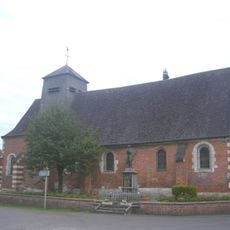
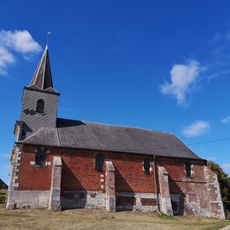
The abbey's name, Bonus fons or "good spring", refers to a water source at the site. The monks quarried slate in the Rumigny area, and around 1660 the abbey's printing press issued several books, including Bertrand Tissier's eight-volume library of the Fathers of Cîteaux. The "Cross of Blanchefosse" from the abbey is now kept in the village church.
Visitors can explore the ruins on the grounds maintained by the Lamotte d'Argy family in Blanchefosse-et-Bay in the French Ardennes. Wearing comfortable walking shoes is advisable, as the terrain is uneven and you will be on foot to see different areas of the site.
The stones used to build the monastery came from a quarry in the nearby town of Bossus-les-Rumigny, connecting the structure directly to local resources. This link to regional materials remains visible in the walls today.
The community of curious travelers
AroundUs brings together thousands of curated places, local tips, and hidden gems, enriched daily by 93,512 contributors worldwide.