Le Thoronet Abbey, Romanesque abbey in Le Thoronet, France
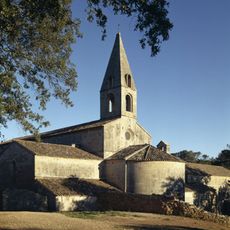
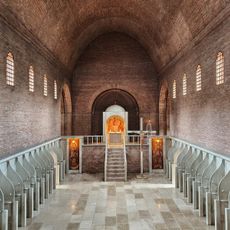
Le Thoronet Abbey is a Cistercian monastery in Provence featuring Romanesque stone architecture with a church, chapter house, cloister, and residential buildings arranged in a compact layout. The entire complex demonstrates the austere building style typical of monastic communities in the medieval period.
Cistercian monks from Mazan founded Notre-Dame de Florièyes near Tourtour in 1136, then moved to Le Thoronet around 1157 on land granted by Raimond-Bérenger, Count of Provence. The monastery was built in one campaign from about 1176 to 1200, the church first. The troubadour Folquet de Marseille became abbot in 1199. Decline set in during the 14th century; the abbey was secularized in 1785 and sold in 1791.
The abbey is one of the "Three Sisters of Provence" with Sénanque and Silvacane. Its first known abbot, Folquet de Marseille, was a celebrated troubadour before becoming a monk in 1195, then Bishop of Toulouse in 1205; Dante placed him in Paradise. The stone walls create a long echo that forced the monks to sing slowly and in perfect unison.
The site is straightforward to visit with clear signage and easy access; parking is available near the entrance. Wearing comfortable shoes is recommended since you will be walking on paved paths and exploring the interior spaces of the complex.
The abbey church's acoustics forced the monks to sing slowly and in perfect unison: the stone walls produced a long echo that imposed discipline on the choir. Le Corbusier visited the abbey in 1953, and in 1964 architect Fernand Pouillon made the building the subject of his novel Les Pierres sauvages, written as the journal of its first prior.
The community of curious travelers
AroundUs brings together thousands of curated places, local tips, and hidden gems, enriched daily by 92,917 contributors worldwide.