Passage Ben-Aïad, Historic covered passage in 2nd arrondissement of Paris, France
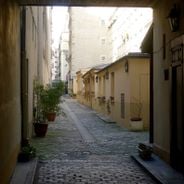
Passage Ben-Aïad is the surviving gallery of the former Passage du Saumon, linking 8, rue Mandar to 9, rue Léopold-Bellan. Its straight walkway has pale stone tiles, beige walls and tall dark-wood-framed windows and doorways, with potted ferns, palms and red-flowered shrubs along both sides. A glass roof section lights the far end, where a metal gate and a rounded arch close the passage; the arch carries carved letters and a foliate stone ornament.
A first open-air Passage du Saumon stood here from 1763. The covered passage with a glass roof was built in 1828 by architect Hubert Rohault de Fleury for the Rohard et Compagnie company, with a 175-metre main gallery and three cross galleries. After 1853 the Tunisian general Mahmoud Ben Aïad bought it; his son Ahmed had most of it demolished in September 1899 for the rue Bachaumont, and the surviving Mandar gallery was renamed Ben-Aïad around 1905.
The name honours Mahmoud Ben Aïad, the wealthy Tunisian general who bought the passage in February 1853; his son Ahmed, who acquired the buildings by auction on 18 June 1884, had most of it demolished in September 1899. The surviving Mandar gallery was renamed "Ben-Aïad" around 1905. The passage appears in Daudet's Le Petit Chose (1868) and Flaubert's L'Éducation sentimentale (1869).
Access is currently limited by metal gates, as this is a private road not freely open to the public. Visitors can view the interior through the iron bars near Les Halles.
The 1997 listing covers not only the passage but also the facades and roofs of the former Bains du Saumon bathhouse. Through the entrance grille, the way to these old baths can still be made out. The surviving gallery is the former galerie Mandar, renamed Ben-Aïad around 1905.
The community of curious travelers
AroundUs brings together thousands of curated places, local tips, and hidden gems, enriched daily by 93,466 contributors worldwide.