Place Pigalle, Square in Quartier Pigalle, Paris, France
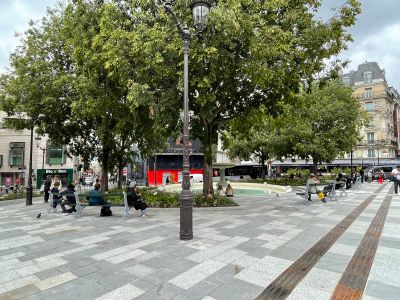
Place Pigalle is a public square in the 9th arrondissement of Paris, between Boulevard de Clichy and Boulevard de Rochechouart, at the foot of the Montmartre hill. At its centre a stone monument, a low wide basin with a raised circular pedestal, stands between two large trees; a tall black lamppost with an ornate top stands to its left, and a low rounded metal barrier runs behind.
The square was originally called Place de la Barrière-Montmartre, named after a nearby city gate, before being renamed in the mid-1800s. In 1871, during the Paris Commune, General Clément Thomas was recognized nearby while dressed as a civilian and was shortly after executed.
The square is named after sculptor Jean-Baptiste Pigalle (1714–1785). Georges Ulmer's song "Pigalle" lists a little jet of water, a metro station and bistros around it. At No. 9 stood the Café de la Nouvelle Athènes, where Paul Sescau opened a studio in 1896; the building burned down in 2004.
The square sits between Boulevard de Clichy and Boulevard de Rochechouart, with Pigalle metro station (lines 2 and 12) opening onto it. From the square, the climb up Montmartre to the Sacré-Cœur begins directly; the streets downhill lead through the Pigalle district.
The neighborhood around the square was known to Allied soldiers in the 1940s as Pig Alley, a nickname tied to its nightlife scene at the time. That reputation has since shifted almost entirely, and the area is now better known for its restaurants, cafes, and independent shops.
The community of curious travelers
AroundUs brings together thousands of curated places, local tips, and hidden gems, enriched daily by 94,512 contributors worldwide.