Murbach Abbey, Religious monument in Murbach, France
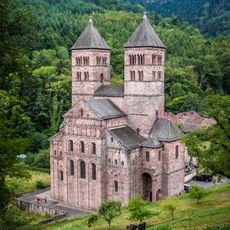
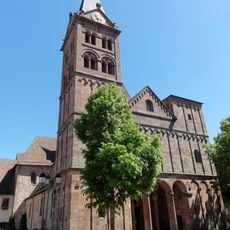
Murbach Abbey is a former Benedictine monastery in the Vosges whose Romanesque church still stands, built of pinkish stone. Two tall square towers with steep grey pyramidal roofs flank a lower central block; rows of arched windows pierce the towers and walls. The nave was destroyed after the French Revolution and its site now serves as a burial ground, leaving the transept and choir.
Count Eberhard of Eguisheim, who had lost his only heir, founded the abbey in 727 and called Saint Pirmin, who came with twelve monks from Reichenau. On 12 July 727 King Thierry IV granted immunity, and on 12 May 728 Bishop Widegern of Strasbourg allowed the monks to elect their abbot freely. In 926 Hungarian raiders devastated the abbey and killed seven monks, venerated as martyrs until the Revolution.
The name Vivarius Peregrinorum, 'Hort of the Pilgrims', recalls the wandering monks Pirmin installed here in 727. The abbey adopted the patronage of Saint Leodegar of Autun, whose head was brought to Murbach in 760; many dependent parish churches took up the same dedication. The porch keystone shows the prince-abbot's arms, a silver greyhound that locals called the 'dog of Murbach'.
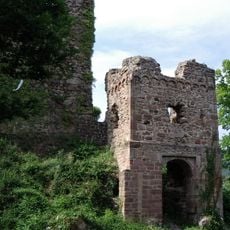
The site is located at the edge of the village and is easy to reach on foot, with views of the surrounding Vosges hills. The best time to visit is in fair weather, when the ruins and cemetery grounds can be explored comfortably.
On the keystone of the entrance porch are carved the arms of the prince-abbot: a silver greyhound that locals once called the "dog of Murbach". The abbey church's ribbed vaults with rectangular cross-section follow a technique developed in Lombardy, at Novara Cathedral and Milan's Sant'Ambrogio.
The community of curious travelers
AroundUs brings together thousands of curated places, local tips, and hidden gems, enriched daily by 94,192 contributors worldwide.