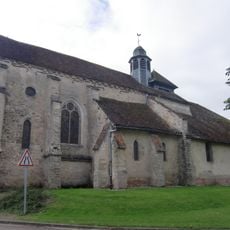
Montiéramey Abbey, Benedictine abbey ruins in Montiéramey, France.
Montiéramey Abbey is a former Benedictine monastery on the Barse, founded in 837 and dissolved in 1790. Its surviving two-storey building has a weathered facade of exposed brick and pale stone, a steep terracotta-tiled roof with three brick chimney stacks, and two rows of tall white-framed windows; a central white door is reached by a short stone stair under a small metal canopy. The south cloister range, abbots' lodging, barn, dovecote and former latrines were listed as monuments historiques in 2001.
A Benedictine monk named Arremar founded the abbey in 837, and it quickly became an important monastic center. By the 12th century, it had grown powerful enough to control fourteen dependent priories across the region.
The abbey's first name was 'la Nouvelle Celle', distinguishing it from Montier-la-Celle. From the 12th century the name of its founder Arremar prevailed, giving 'Moustier Arramé' (1182–1594), contracted to 'Monstierarramey' (1353) and 'Moutieramey' (1472), before becoming 'Montiéramey' in 1619. The abbey held relics of the hermit saint Victor of Plancy, translated there in 837, which made it a pilgrimage centre.
The buildings were designated as a protected historical monument in 2001 and now function as private residences, which limits visitor access. It is best to check locally for any public viewing opportunities before planning your visit.
The abbey's surviving archives are held at the Bibliothèque nationale de France, notably its cartulary and several liturgical works. Its illuminated manuscripts of Peter Lombard, by contrast, are kept in Troyes at the Bibliothèque municipale, as MSS 304, 175 and 7. The oldest document in the Aube archives is Charles the Bald's 854 charter granting the abbey rights and domains.
The community of curious travelers
AroundUs brings together thousands of curated places, local tips, and hidden gems, enriched daily by 94,571 contributors worldwide.