Apocalypse Tapestry, Medieval tapestry series at Château d'Angers, France
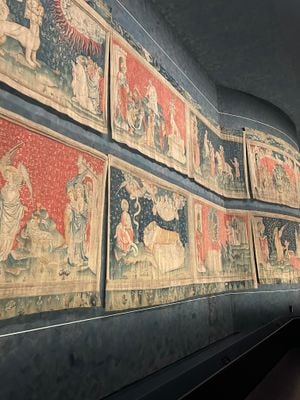
The Apocalypse Tapestry is a set of six wool tapestries woven in Paris between 1377 and 1382, now shown in a gallery at Château d'Angers. Each section is about 24 metres wide and 6.1 metres high, and the six originally held 90 scenes with alternating red and blue backgrounds. The panels show angels with halos and long staffs, red scaly dragons pierced by lances, and a pale architectural frame at the left edge.
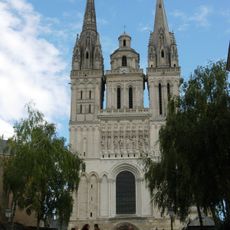
Louis I, Duke of Anjou, commissioned the tapestry around 1373 from the Paris merchant Nicolas Bataille, who had it woven in Robert Poinçon's workshop after designs by Jean Bondol, court painter to Charles V. It was completed by 1380 or 1382 at a cost of 6,000 francs. René of Anjou bequeathed it to Angers Cathedral in 1480, and it was moved to the Château d'Angers in 1954.
The name comes from the Book of Revelation, whose Anglo-French Gothic cycle Louis I chose, partly from a manuscript lent by his brother Charles V in 1373. At Angers Cathedral the hangings were unrolled for Easter, Pentecost, All Saints, Christmas and the feast of Saint-Maurice, the city's patron. In 1400 the set decorated the archbishopric of Arles for the wedding of Duke Louis II.
The tapestry hangs in a gallery built for it in 1954 by architect Bernard Vitry at Château d'Angers, with light and ventilation controls added between 1990 and 2000. The six sections are each about 24 metres wide and 6 metres high, so allow time to walk the full length and read the scenes in order.
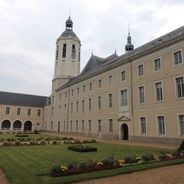
The tapestry survived the Revolution only because it was woven in wool, not silk or metal thread: many medieval tapestries were burned to recover their gold and silver. Canon Louis-François Joubert found it in 1848 in a damp room of the old Angers seminary, cut into fifteen parts and 58 scenes mounted four by four without order.
The community of curious travelers
AroundUs brings together thousands of curated places, local tips, and hidden gems, enriched daily by 93,575 contributors worldwide.