Château d'Angers, Medieval fortress in Angers, France
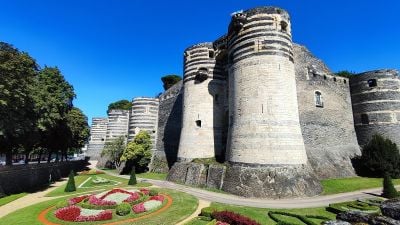
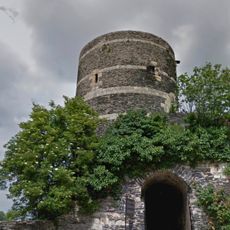
Château d'Angers is a fortress on a slate promontory above the Maine, with an outer wall about 660 m long and 3 m thick, defended by 17 round towers 18 m in diameter. The towers are built of pale limestone and dark slate, giving a banded appearance, and were once 40 m high before being cut down for artillery; the Tour du Moulin keeps its original height.
The site was occupied since antiquity; in 851 the Bishop of Angers allowed the Count of Anjou to settle near the Roman wall. Louis IX rebuilt the castle in the 13th century with white stone and black slate, 17 semicircular towers, and an outer wall 3 metres thick and about 660 metres long. In 1352 John II gave it to his son Louis, who commissioned the Apocalypse Tapestry in 1373.
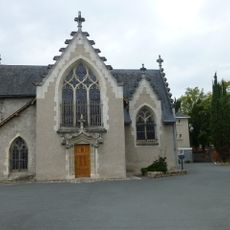
The Apocalypse Tapestry was commissioned in 1373 by Louis I, Duke of Anjou, from the painter Hennequin de Bruges and the Paris weaver Nicolas Bataille. It has hung in the castle since 1954. The chapel built by Louis II and Yolande of Aragon between 1405 and 1412 held a splinter of the True Cross acquired by Louis IX.
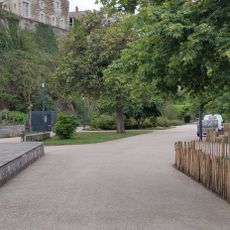
Visiting is made easy by well-maintained pathways that allow exploration of different sections and climbing the towers. Clear signage and information boards help you navigate the site and understand what you are seeing.
During World War II, German forces used the fortress as a weapons depot, and traces of this use remain visible in certain areas today. This layer of history shows how the site survived and changed through different eras.
The community of curious travelers
AroundUs brings together thousands of curated places, local tips, and hidden gems, enriched daily by 93,401 contributors worldwide.