Stade de la Mosson, Multi-purpose sports venue in La Paillade, Montpellier, France
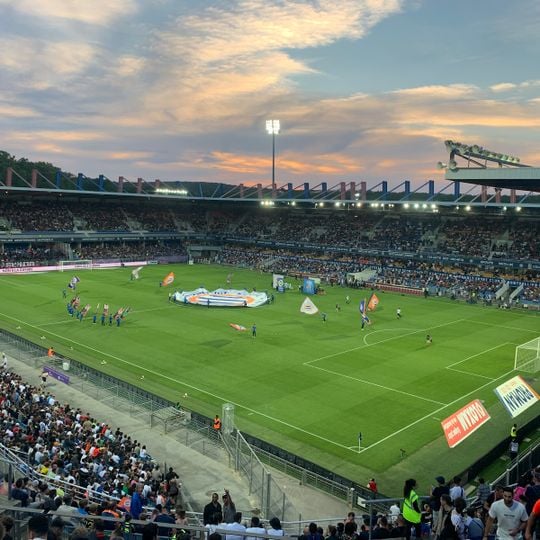
Stade de la Mosson is a football stadium in the La Paillade district of Montpellier, renamed Stade de la Mosson-Mondial 98 after the 1998 World Cup. Its four stands were built between 1988 and 1997, and the three-level honour stand dates from the works completed on 4 June 1997. The facade carries orange and blue fins above a white band reading "montpellier métropole".
The stadium opened in 1972 and became the home of Montpellier Paillade Sport Club in 1974. In 1977, after a Coupe de France match against Nîmes Olympique, a stand was brought from Annecy and the ground was expanded to 18,000 places in three weeks. The current stands were built between 1988 and 1997, and the stadium was delivered on 4 June 1997 after two years of works costing 130 million francs for the 1998 FIFA World Cup.
The stadium is named after the Mosson, the river whose cévenol-storm floods have repeatedly damaged the ground. The nickname "la Butte" survives from 1977, when supporters built an earth bank with railway sleepers behind a goal; it now designates the Étang de Thau stand. In 1980, after eliminating Saint-Étienne, the ground was called "la marmite du diable".
The stadium sits in La Paillade, beside the Mosson river, and is managed by Montpellier Méditerranée Métropole. The Mosson stop on tram line 1 serves the ground. The Mosson's floods during Cévenol storms have damaged the stadium, so check conditions after heavy rain.
The stadium's record attendance came on 19 March 1991, when 22,453 spectators watched Montpellier HSC play Manchester United in a European Cup Winners' Cup quarter-final. In 1980, after eliminating Saint-Étienne in the French Cup, the ground was nicknamed "la marmite du diable", with some fans perched in the trees overlooking the pitch.
The community of curious travelers
AroundUs brings together thousands of curated places, local tips, and hidden gems, enriched daily by 93,406 contributors worldwide.