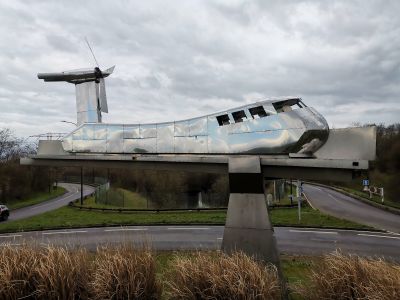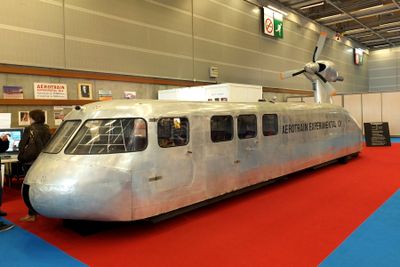
Aérotrain, Memorial in Gometz-la-Ville, France
Aérotrain is an experimental transport system near Orléans in France that hovered on an air cushion above a special concrete track. The futuristic capsule with silver cladding and large windows stretched across several segments and was designed for high-speed connections between French cities.
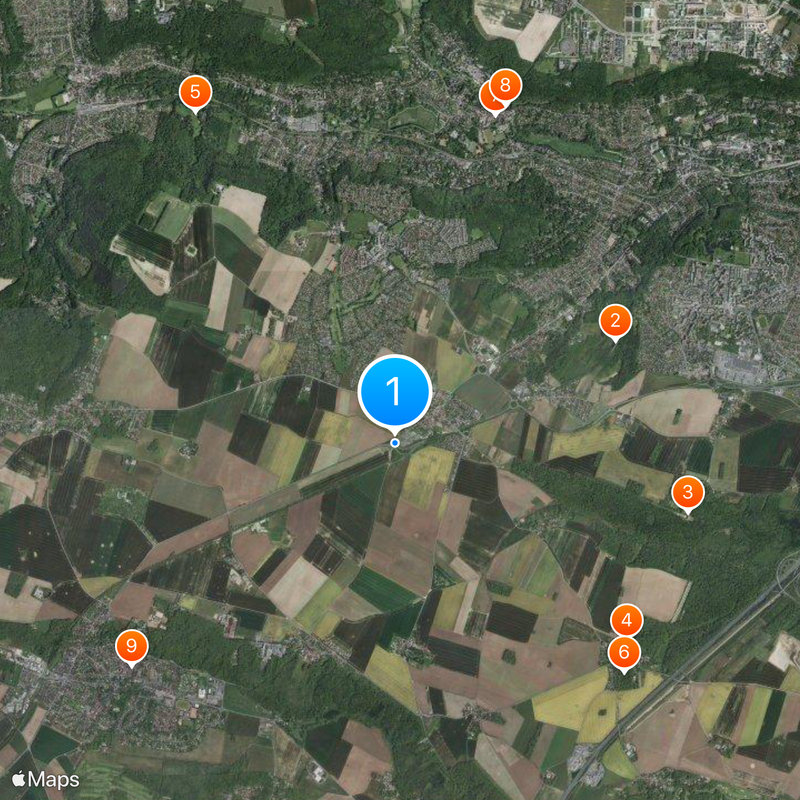
Jean Bertin's team patented the Aérotrain concept on 26 June 1962, after Louis Duthion's 1957 ground-effect tests. The first 6.7 km concrete test track opened in February 1966 at Gometz-le-Châtel, and an 18 km elevated track between Saran and Ruan north of Orléans followed in 1969. President Valéry Giscard d'Estaing cancelled the Cergy–La Défense line in 1974, and SNCF shifted support to the TGV.
The name combines "aéro" and "train", reflecting the fusion of aviation technology with ground transport. The vehicle hovered on an air cushion above a T-shaped concrete track, producing a distinctive whistling sound as it passed by.
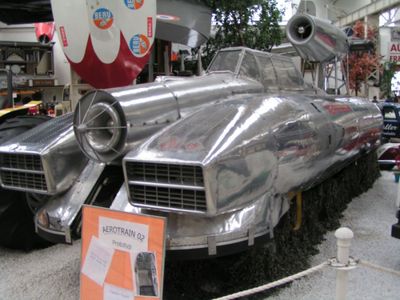
Parts of the original concrete track remain visible today and can be seen from the road. One prototype was preserved at the railway museum in Mulhouse.
The I80 prototype reached a speed of 417.6 kilometers per hour (259.5 mph) in 1974, setting a record for ground vehicles on the track. Two turbine engines with ducted propellers allowed rapid acceleration and braking between stations.
The community of curious travelers
AroundUs brings together thousands of curated places, local tips, and hidden gems, enriched daily by 94,049 contributors worldwide.