Strasbourg-Ville station, Railway station in Gare-Tribunal district, Strasbourg, France
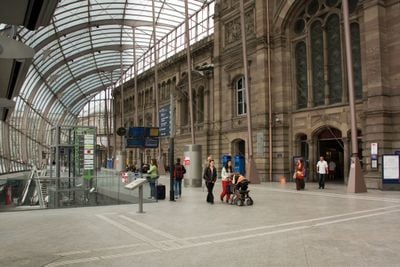
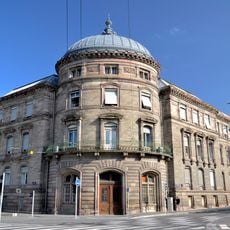
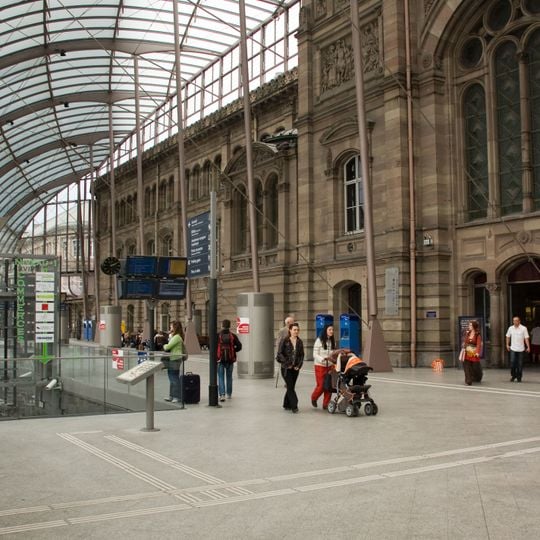
Strasbourg-Ville station is a stone station building of 1883 by Berlin architect Johann Eduard Jacobsthal, modelled on Hanover's central station. Grey stone arcades and round-arched windows rise to sandstone-toned upper storeys, and a rounded portal with carved stonework marks one side. Since 2006–2007 a curving glass canopy on steel columns covers the forecourt in front of the historical façade.
The current building was completed in 1883, replacing an earlier station from 1852 that had been constructed during German administration of Alsace following the Franco-Prussian War. The new construction reflected Strasbourg's growing importance as a major railway hub during that period.
The two over-life-size female figures of Industry and Agriculture in the main hall were carved by Berlin sculptor Otto Geyer, who also signed the figured reliefs on the sandstone façade. The station's first trains were greeted in 1883 in a building that was the first in Strasbourg lit entirely by electricity.
Tram lines A and D stop in the underground station beneath the building, opened with line A on 25 November 1994; line C, opened in 2010, stops overground on Place de la gare. CTS buses 2 and 10 and BRT lines G and H also serve the station. The station lies at 143 m altitude, and trains run at a 30 km/h limit through the six platform tracks.
A special waiting area and staircase were built in 1900 specifically to accommodate German Emperor Wilhelm II when he visited during the period of German rule. This detail reveals how the station was designed to serve important state moments alongside everyday travel.
The community of curious travelers
AroundUs brings together thousands of curated places, local tips, and hidden gems, enriched daily by 94,392 contributors worldwide.