Château de Lichtenberg, 13th century castle in Lichtenberg, France
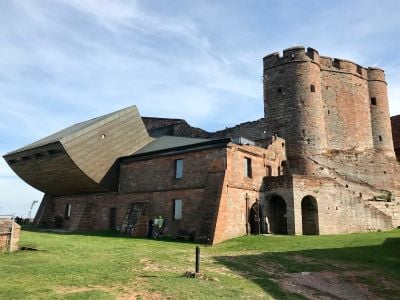
Château de Lichtenberg is a ruined hilltop fortress above the village of Lichtenberg in the northern Vosges, at 480 metres. A broad, deep moat allows access at only one point; from the moat the walls appear as high, smooth masonry without windows. Inside are terraces and lawns, the 15th–16th-century western dwelling with round windows, the 16th-century arsenal, a free-standing auditorium, and a late-Gothic chapel dedicated to the Trinity.
The castle was built around 1230 by the Lords of Lichtenberg as a fief of the Bishop of Strasbourg. In 1570 Count Philipp V of Hanau-Lichtenberg commissioned Daniel Specklin, architect of Strasbourg, to modernise the defences. French troops under Marshal Créquy took it in 1678 after an eight-day siege, and on 9 August 1870 Württemberg artillery set it ablaze, leaving it a ruin.
The late-Gothic castle chapel, dedicated to the Holy Trinity, served the village of Lichtenberg as its church, since the village had none of its own. On the side facing the towers, a painting of Saint Christopher was once visible. Since 1913, amateur actors have performed open-air theatre in the castle, a tradition that continues with the Théâtre de Lichtenberg.
From the car park in the centre of Lichtenberg, footpaths lead up to the castle in about 10 minutes. The site is surrounded by a broad, deep defensive ditch that allows access at only one point. Parts of the castle and all exhibition rooms are accessible to visitors with reduced mobility.
The castle stands on a hill at 480 m, and from the artillery terrace laid out in 1840 the view opens all around. The site is ringed by a broad, deep defensive ditch that leaves only one point of access; from the ditch the walls show as high, smooth surfaces without windows.
The community of curious travelers
AroundUs brings together thousands of curated places, local tips, and hidden gems, enriched daily by 94,106 contributors worldwide.