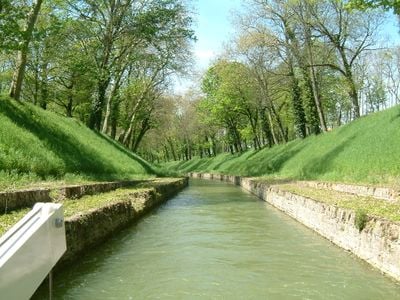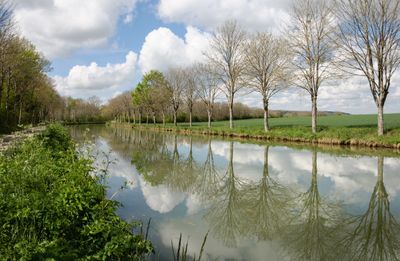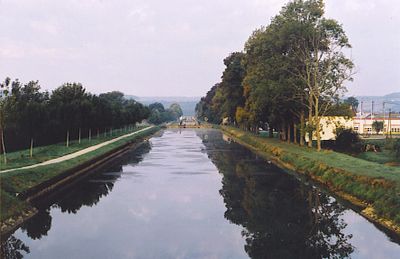
Canal de Bourgogne, Navigation waterway in Burgundy, France
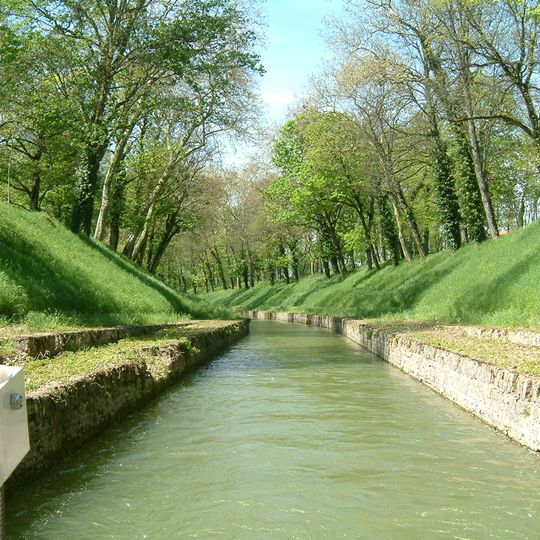
The Canal de Bourgogne is a navigation waterway extending 242 kilometers through eastern France, linking the Yonne River to the Saône River. The system includes 189 locks, reaches its summit at 378 meters elevation, and features a 3.3-kilometer tunnel at Pouilly-en-Auxois.
The idea of a canal linking the Channel to the Mediterranean was raised as early as 1605 under Henry IV, and the route through the Armançon, Vandenesse and Ouche valleys was chosen after many alternatives were studied. Louis XV signed the edict ordering construction on 7 September 1773, and work began in 1777 on the Laroche–Tonnerre section. The canal was completed and inaugurated in 1832, with 189 locks and a 3.3 km tunnel at Pouilly-en-Auxois.
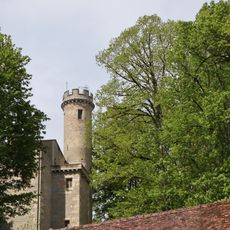
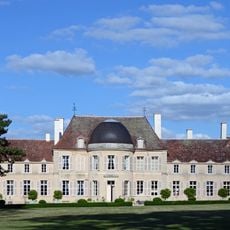
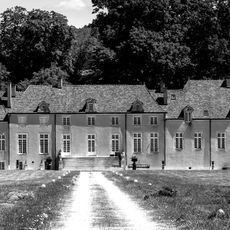
The canal is sometimes called the "canal des Deux-Mers" because it links the English Channel and the Mediterranean. Along its route, boaters pass the Renaissance château of Tanlay, the 16th-century château of Ancy-le-Franc, and the ironwork forge built by the Comte de Buffon at Buffon. The canal also passes through Tonnerre, birthplace of the Chevalier d'Eon.
Boats need a fixed or hand-held spotlight to pass through the 3.3 km Pouilly-en-Auxois tunnel, a rule introduced after a fatal accident inside it. The summit reach at Pouilly-en-Auxois has a fully equipped port near the town centre, and the descent towards the Saône includes 40 locks in 14 km. The straight final 30 km across the Saône plain has few bends apart from a slight turn near Thorey-en-Plaine.
Workers created 32 vertical shafts during tunnel construction at Pouilly to remove excavated materials, which now serve as ventilation channels for passing boats. This practical solution reveals how 19th-century engineers combined immediate needs with lasting design.
The community of curious travelers
AroundUs brings together thousands of curated places, local tips, and hidden gems, enriched daily by 94,563 contributors worldwide.