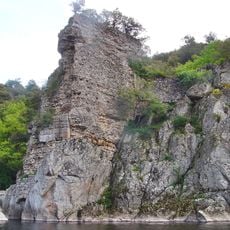
Pierregourde, Medieval castle ruins in Gilhac-et-Bruzac, France.
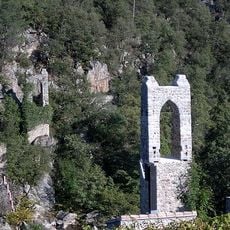
Château de Pierregourde is a ruined stone castle on a rocky rise above Gilhac-et-Bruzac, at over 600 metres. Three tall broken wall sections remain, the tallest with two empty window openings; a lower wall with a small window and faint red graffiti stands to the right, and a thin isolated stone pillar survives further on. The ruins lie on private land with no public access.
Built in the 13th century, the castle is first documented through Hugues I de Pierregourde in 1237. The lordship passed by marriage to the La Marette family in 1325 and later to the Barjac family. In 1630 Cardinal Richelieu had it destroyed; after abandonment in the 17th century it served as a stone quarry, which caused most of the ruin.
The name comes from old French for "stone watchtower". Two families held the lordship in succession: the Pierregourde, attested in 1237 with Hugues Ier, then the La Marette from 1325, when Hugues IV married Diane de la Marette. The line ended in 1568 with Louis de Pierregourde, killed after joining the Protestant side.
The site is accessible via RD266 from Saint-Laurent-du-Pape, but it sits on private property and visits require prior permission. Travelers should make arrangements beforehand and respect the property boundaries when exploring the area.
Archaeological research has uncovered evidence of metalworking activities at the site from the 12th to 17th centuries. This discovery reveals that the castle also functioned as a workshop or production center, not merely as a fortress.
The community of curious travelers
AroundUs brings together thousands of curated places, local tips, and hidden gems, enriched daily by 94,657 contributors worldwide.