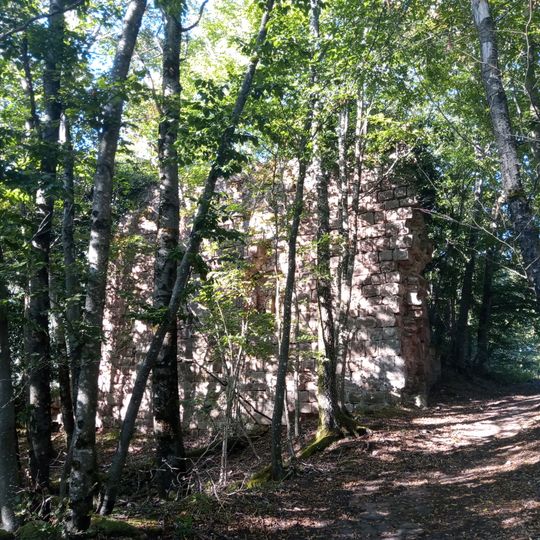
Château de Turquestein, Medieval castle ruins near Turquestein-Blancrupt, France.
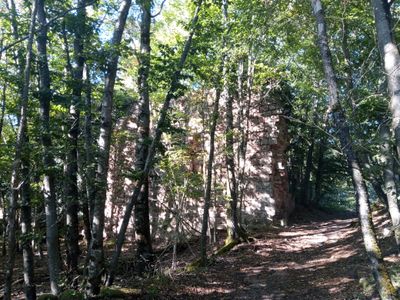
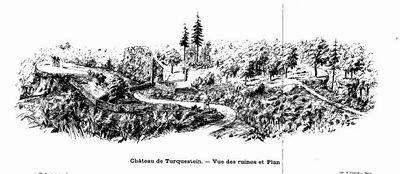
Château de Turquestein stands in ruins on a rocky plateau at 458 metres above the White Saar valley, near the Donon. Its surviving core is a curtain wall of bossed ashlar about twelve metres high, dated to the late 12th century, with a rectangular opening near its broken top. A masonry arch once bridged a rock fissure, and a lower bailey lay to the west.
Built around 965 to guard the Donon trading route, the fortress passed between the jurisdictions of the Toul and Metz bishops. Its dismantling came in 1634 on orders from Cardinal Richelieu.
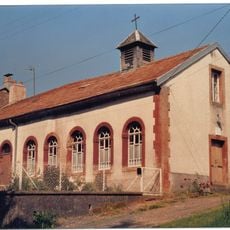
In 1797 Joseph Ludwig Colmar, Louise Humann and Madame Breck sealed a prayer pact in the ruins; the Congregation of Notre-Dame de Sion grew from it. A commemorative altar was set up among the ruins in 1954, incorporating a cross found on the site, and a plaque marking the congregation's bicentenary was added in 1997.
The site is not maintained and part of the north curtain wall and the vaulted cellar have recently collapsed, so keep to the marked path and avoid the base of unstable masonry. The ruins stand at 458 metres on a rock plateau above the White Saar valley, reached by a winding forest path.
The German name Türkstein, or Türkenstein, means "Turk's Stone" and has nothing to do with Thor. The castle gave its name to the lordship of Türkstein, whose territory around 1305 reached as far as the Vezouze and included villages on the White and Red Saar.
The community of curious travelers
AroundUs brings together thousands of curated places, local tips, and hidden gems, enriched daily by 93,935 contributors worldwide.