Odéon-Théâtre de l'Europe, Monument historique classé theatre in 6th arrondissement, Paris, France
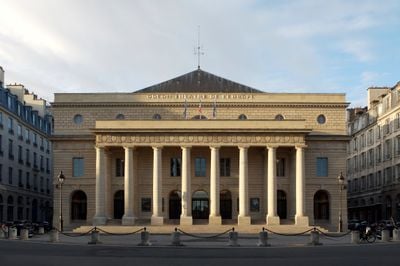
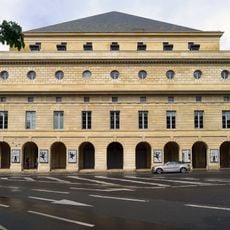
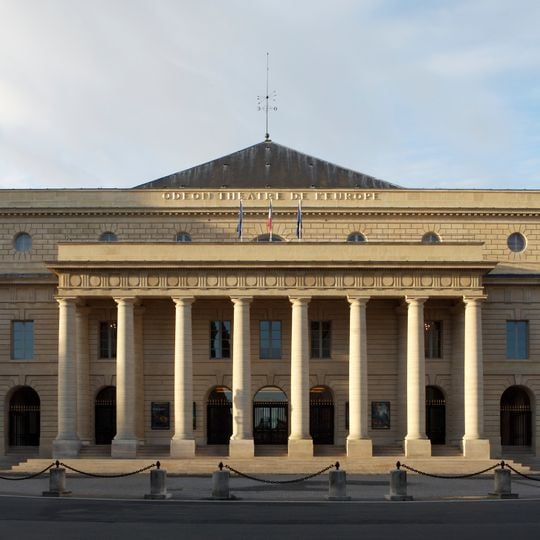
The Odéon-Théâtre de l'Europe is a long neoclassical stone building in pale cream, its upper facade inscribed "ODEON THEATRE DE L EUROPE" beneath a low dark pyramidal roof with a slender metal weather vane. A colonnade of ten smooth columns on square bases, grouped three at each end and four in the middle, stands above a broad stepped platform, with doors and windows between the columns. Round-arched doorways and rectangular windows continue to the sides, and a row of small round windows runs beneath the roofline.
The first theatre, designed by Charles de Wailly and Marie-Joseph Peyre, opened in 1782 and hosted the premiere of Beaumarchais's The Marriage of Figaro in 1784. It burned down in 1799; a reconstruction by Jean-François Chalgrin burned in 1818. The present building, by Pierre Thomas Baraguay, opened in September 1819 and was renamed Odéon-Théâtre de l'Europe in 1990.
The name Odéon, adopted in 1796, refers to the odeons of ancient Greece, and the venue was meant to serve as a dramatic school for the regeneration of the art. Since March 1990 it has been called Odéon-Théâtre de l'Europe and belongs to the Union of the Theatres of Europe, taking part in co-productions and multilingual projects. Its director since 15 July 2024 is Julien Gosselin.
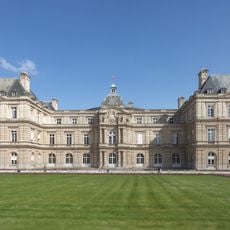
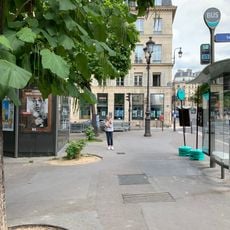
The theatre is located near the Luxembourg Gardens and easily reached from Odéon metro station on lines 4 and 10. The neighborhood is walkable with clear street signs to help you find the building.
The name Odéon comes from the ancient Greek odeons, and was adopted in 1796 by the Dorfeuille company, which wanted to make the theatre "a dramatic school useful to the regeneration of art". The venture went bankrupt in October 1797, leaving the theatre only its name.
The community of curious travelers
AroundUs brings together thousands of curated places, local tips, and hidden gems, enriched daily by 93,861 contributors worldwide.