Ronc Traoucat dolmens, Prehistoric burial site in La Grand-Combe, France.
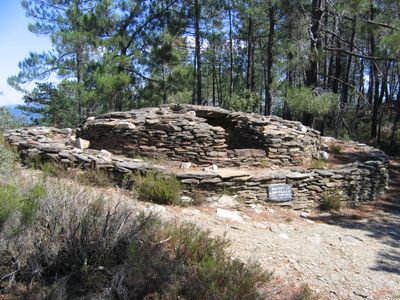
Ronc Traoucat is a megalithic complex of six separate burial chambers arranged as a necropolis and built from large stone slabs. Each structure forms a distinct grave site with raised stone platforms that frame the individual monuments.
The six dolmens were built in the Bronze Age, roughly 2700–1800 BC, and were reused during the Iron Age. They belong to the late dolmen tradition of the Epi-Chassey-Lagozza-Cortaillod cultures of southern France. Dolmen no. 3, reused as a hunters' hide and dug over by clandestine excavators, was restored in 1983 by the Groupe alésien de Recherche archéologique.
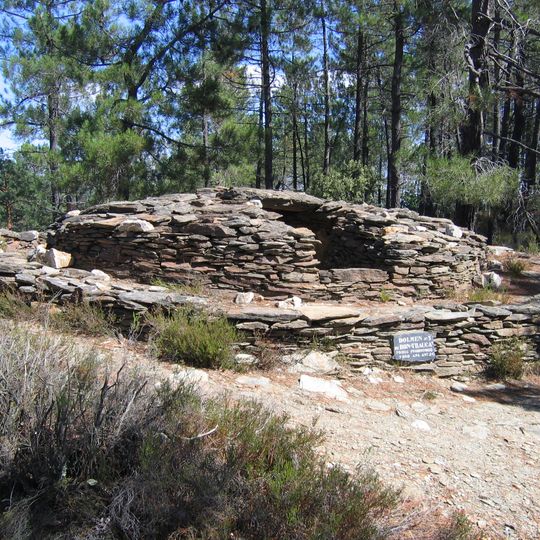
The name Ronc Traoucat is Occitan. Dolmen 3 was long used as a hunting hide before the Groupe alésien de Recherche archéologique restored it in 1983; its dry-stone walling patched the broken north and south slabs. Excavation there yielded 219 round steatite beads, an oval arrowhead, a perforated micaschist pebble and pottery fragments.
The six dolmens lie on a ridge in the Cévennes above the commune of Soustelle, in the Gard department of Occitanie, not in Languedoc-Roussillon. Dolmen 3, restored in 1983, keeps its 5.50 m tumulus and dry-stone walling; dolmens 1, 2 and 4 are almost destroyed. The ground is bare earth with dry vegetation, so sturdy shoes help.
Dolmen 3 is the only dolmen in the entire Cévennes whose tumulus is ringed by a facing wall of small flat stones and eight large blocks of milky quartz. Its covering slab is split in two and rests on three upright stones; the broken north and south slabs were completed with dry-stone walling in 1983.
The community of curious travelers
AroundUs brings together thousands of curated places, local tips, and hidden gems, enriched daily by 95,178 contributors worldwide.