Pierre de la Fée, Prehistoric dolmen in Draguignan, France.
Pierre de la Fée is a dolmen of local limestone whose covering slab, about 6 m long, 4.7 m wide and 0.58 m thick, rests on upright stones roughly 2.2 m high. Only two orthostats and the headstone remain; a third support still stood in 1996. The slab's front edge is thick and uneven, and a pale rounded stone stands at the left beneath it.
The dolmen dates from the late Neolithic; its funerary material, found in the 1844 excavation, was later dated to the Chalcolithic. The 1844 dig yielded a flint arrowhead, two bone buttons, an oval lead bead and human bones. Classified as a monument historique in 1889, it was restored in 1951, and in 1975 a local opponent of the prefecture's transfer to Toulon dynamited it.
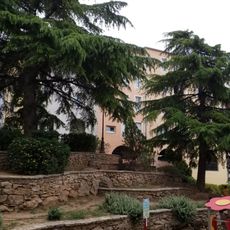
Local legend holds that women struggling to conceive came to the dolmen to seek the fairy Esterelle, who helped them become pregnant. The name "Pierre de la Fée" has since been reused for a retirement home, a residential building and a bus stop of the Transports de Dracénie in Draguignan.
The site is located approximately one kilometer northwest of Draguignan, accessible via the Montferrat route through the surrounding landscape. A parking area is available at the location, making it convenient for visitors to explore the stone structure at their own pace.
In 1975 a resident of Draguignan, angered by the transfer of the Var prefecture to Toulon the previous year, blew up the dolmen with explosives. The 1951 restoration had already reinforced the base of every slab with a concrete footing and cut into the trunk of the centuries-old oak behind the headstone to ease its pressure on the monument.
The community of curious travelers
AroundUs brings together thousands of curated places, local tips, and hidden gems, enriched daily by 93,443 contributors worldwide.