Sanatorium d'Aincourt, Historical tuberculosis hospital in Aincourt, France
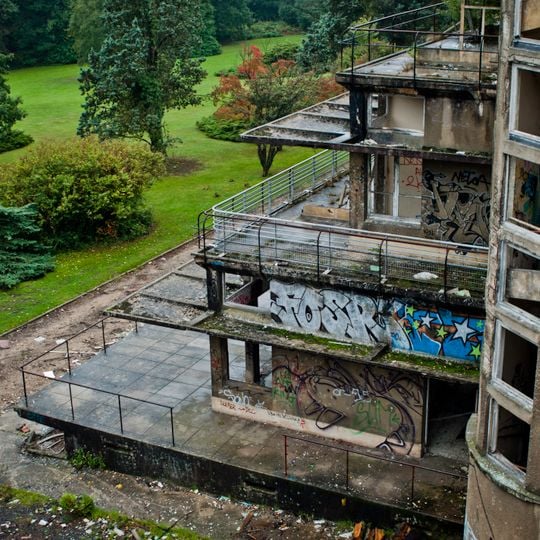
The Sanatorium d'Aincourt is a reinforced concrete medical facility featuring three identical buildings spaced approximately 400 meters apart. Each structure includes extensive terraces and frosted glass dividers between patient rooms to maximize light and air circulation.
The complex was built between 1931 and 1933 as a treatment facility using fresh air therapy for tuberculosis patients. During World War II, it was converted into an internment camp for suspected resistance members.
The buildings were designed with wide windows and open loggias to give patients maximum air circulation throughout their stay. This architectural approach still defines the structures today and reflects medical beliefs of the interwar period.
The site lies in the 73-hectare Parc de la Bucaille, 55 km northwest of Paris in the Vexin français. One pavilion still houses the Centre hospitalier du Vexin, while the other two stand abandoned and fenced off, so the complex is not open to visitors. A commemorative stele erected in 1994 stands on the grounds, and a ceremony is held there on the first Saturday of October.
Between the Cedars and Tamaris pavilions lies a Japanese garden laid out in 1970 on the initiative of Dr Hamon, then director of the Centre Médical de la Bucaille and a follower of Zen philosophy. Its design follows the Sakutei-ki treatise, with a waterfall, island and small bridge modelled on the Sambô-in garden and a ritual torii gate recalling the shrines of Nara.
The community of curious travelers
AroundUs brings together thousands of curated places, local tips, and hidden gems, enriched daily by 94,045 contributors worldwide.