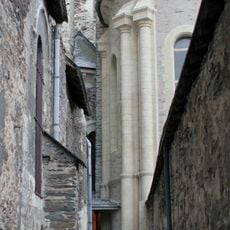
Musée Jean Lurçat, Tapestry museum in Angers, France
The Jean Lurçat Museum occupies a medieval building that dates back to the 12th century and displays modern textile artworks and tapestries throughout its rooms. The collection features works ranging from post-war pieces to recent creations by contemporary artists exploring new approaches to fiber-based art.
The museum occupies the 12th-century Hôpital Saint-Jean and a 17th-century former orphanage beside it. Jean Lurçat's ten tapestries of Le Chant du monde, woven between 1957 and 1966, have been shown in the hospital's great patients' hall since 16 May 1968. The museum was conceived as a modern counterpart to the medieval Apocalypse Tapestry of Angers.
The museum's core holdings come from donations by Jean Lurçat, Thomas Gleb and Josep Grau-Garriga, joined by works of Yves Millecamps, Mario Prassinos, Michel Tourlière and Robert Wogensky. The display follows tapestry from after the Second World War to the Nouvelle Tapisserie and fiber art, with pieces by Fanny Viollet, Simone Pheulpin and Patrice Hugues. Two temporary exhibitions a year focus on textile research.
The Chant du monde hangs in the former patients' hall of the medieval Saint-Jean hospital, while the rest of the collection fills a 17th-century former orphanage next door, so allow time to move between the two buildings. The tapestries are mounted low along the walls, which lets you read the woven bands of text up close.
The ten panels of Le Chant du Monde were woven between 1957 and 1966, and Jean Lurçat intended them as a modern counterpart to Angers' medieval Apocalypse Tapestry. He called the cycle a song of the world, and its imagery points to the atomic bomb as the apocalypse of the 20th century. The ensemble has been shown in the former patients' hall of the Hôpital Saint-Jean since 16 May 1968.
The community of curious travelers
AroundUs brings together thousands of curated places, local tips, and hidden gems, enriched daily by 93,420 contributors worldwide.