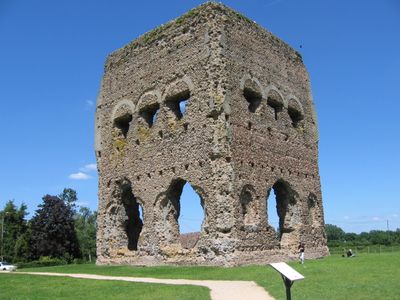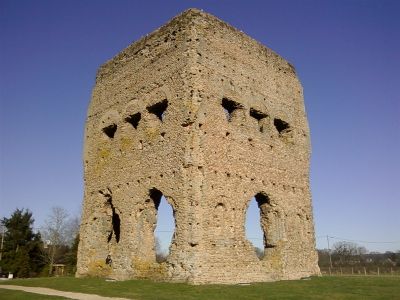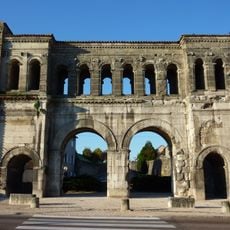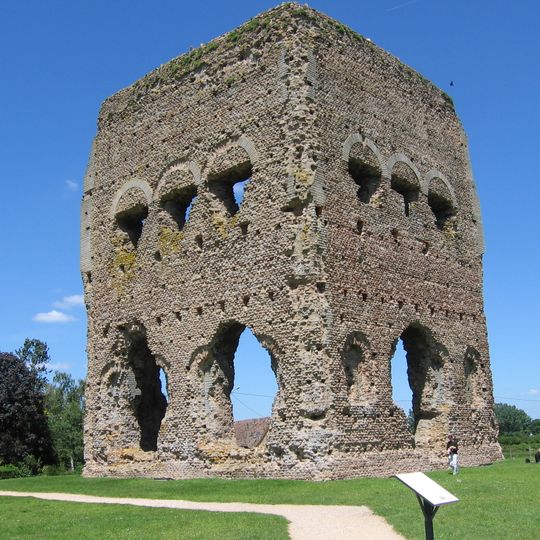
Temple of Janus, Roman temple in Autun, France.
The Temple of Janus is a Romano-Celtic fanum in Autun whose square cella, about 16.8 by 16.35 metres, preserves its south and west walls to roughly 24 metres, the highest standing Roman temple walls in Gaul. The walls are 2.2 metres thick, faced with small square sandstone blocks and pierced by putlog holes from the scaffolding. Inside, four large arched niches and a central semi-dome that probably held the cult statue remain; the floor was opus sectile.
The site of la Genetoye was occupied from Neolithic times; excavations from 2012 revealed La Tène and Augustan-era remains beneath the temple, perhaps an earlier Gaulish sanctuary. The temple itself was probably built in the second half of the 1st century CE, like the other monuments of Augustodunum. Abandoned at the start of the Early Middle Ages, its cella was reused in a medieval fortification with a ditch, which helped preserve it. It was listed as a monument historique in 1840.
The name "Janus" comes from a 16th-century misinterpretation by the historian Pierre de Saint-Julien de Balleure, who read the place-name la Genetoye (land where broom grows) as a form of Jani tecto. The deity worshipped here is unknown. A panel near the temple explains this.
The site sits on Rue du Faubourg Saint-Andoche and welcomes visitors year-round without restriction, with parking available nearby. Since it stands outdoors, wear appropriate clothing for the weather and expect uneven ground as you move around the ruins.
The name "Janus" is a 16th-century error: the historian Pierre de Saint-Julien de Balleure read the place-name la Genetoye, meaning ground where broom grows, as a corruption of Jani tecto, "roof of Janus". The deity worshipped here is unknown, and a plaque near the walls repeats this correction.
The community of curious travelers
AroundUs brings together thousands of curated places, local tips, and hidden gems, enriched daily by 93,537 contributors worldwide.