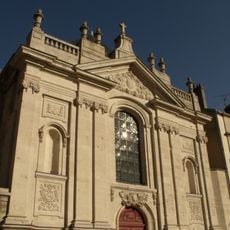
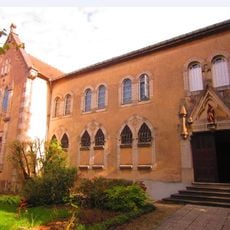
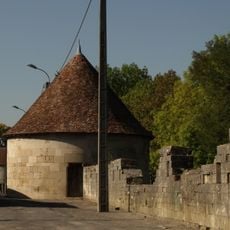
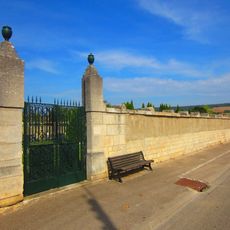
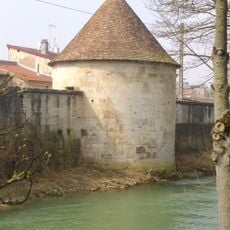
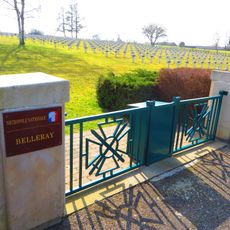
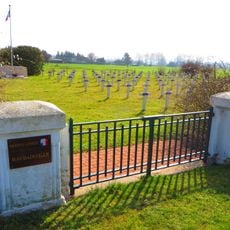
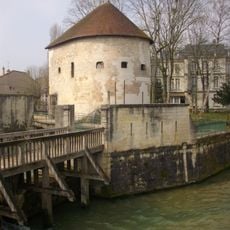
Fort Belrupt, Military fortification in Belrupt-en-Verdunois, France.
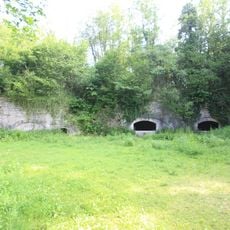
Fort Belrupt is a first-generation Séré de Rivières fort on a hill at 347 m east of Verdun, built 1875–1877 as one of the "redoutes de la panique". Its pentagonal plan has a recessed gorge; the entrance tunnel, preceded by a ravelin on the glacis, opens at the centre of a deep curtain wall holding two levels of barracks. All masonry is covered with earth, and the artillery stood in the open behind ten bombproof traverses.
The fort was built in 1877 as part of France's Séré de Rivières defensive system along the border. During World War I's Battle of Verdun, it functioned as an artillery position and provided shelter for troops.
The name Fort Corda, given in 1887, honoured Joseph Corda, a general of artillery born in Belrupt on 26 November 1773 who took part in the sieges of Luxembourg, Ehrenbreitstein and Danzig. The decree was revoked on 13 October 1887, but the Boulanger name stayed carved on the entrance pediment, where visitors can still read it.
The fort stands at 347 m, above the roads to Étain (D603, north) and Metz (D903, south). It is privately run by a paintball club and lightly renovated since 2004, so visits are not directly possible; the surrounding land toward the Caserne Chevert offers views of smaller installations.
The fort has no true powder magazine: that role fell to two small rooms opening off the passages in the right-hand part of the fort. Artillery stood in the open, with ten traverses giving the crews shelter during bombardment. The entrance tunnel leads into a narrow light-well courtyard lined by eight magazines in two rows of four.
The community of curious travelers
AroundUs brings together thousands of curated places, local tips, and hidden gems, enriched daily by 94,524 contributors worldwide.