Le Puy Cathedral, Romanesque cathedral on Mont Anis, Le Puy-en-Velay, France.
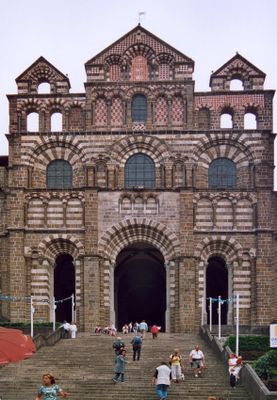
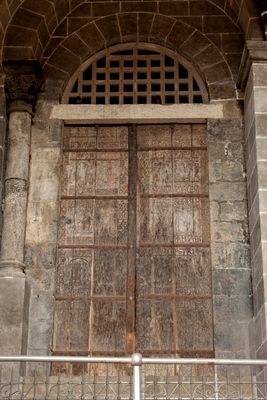
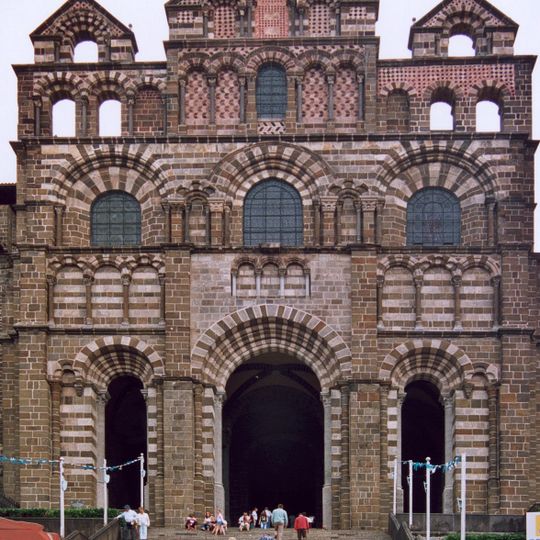
Le Puy Cathedral, or Notre-Dame-de-l'Annonciation, stands at the highest point of Le Puy-en-Velay, below the Rocher Corneille. Its west front is built of alternating light and dark stone in three tiers: three round-arched portals below, three large arched windows above, and a row of smaller banded arches topped by two gables. The cedar door leaves carry carved panels and the names LE BARON, PALAZZEN, PETAL and BENOIT.
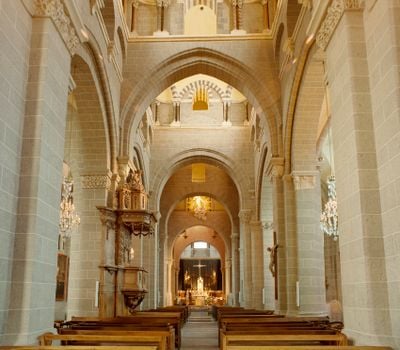
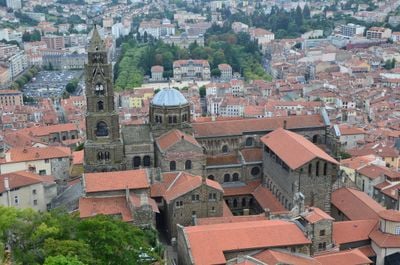
Construction of the present cathedral began in the late 5th century under Bishop Scutarius, not in the 11th century. A 9th-century church was rebuilt in Carolingian style in the 10th century, then enlarged from the mid-11th century with a transept, dome and octagonal lantern tower. The bulk of the building dates from the first half of the 12th century, when the west porch, cedar doors and multicoloured stone facade were added.
Le Puy Cathedral is one of the main starting points for pilgrims walking to Santiago de Compostela, and this role is still visible today. Just outside the doors, walkers gather, check their gear, and take their first steps on the long road south.
The west entrance is reached by a stairway that climbs from the town below to a porch set just under the nave; the 12th-century cedar doors and the banded west front stand at its top. The cloister and the Hôtel-Dieu lie on the north side of the cathedral, and the Saint-Mayol tower, cut down to its lower two levels in 1948, rises beside them.
The Black Madonna venerated inside the cathedral today is not the original figure: the earlier statue was destroyed during the French Revolution, and the current one was carved in the 19th century. It was modeled on old descriptions of the lost original so that the tradition could continue.
The community of curious travelers
AroundUs brings together thousands of curated places, local tips, and hidden gems, enriched daily by 93,454 contributors worldwide.