Coutances Cathedral, Gothic cathedral in Coutances, France
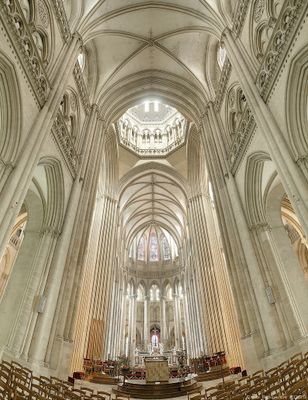
Coutances Cathedral is a Gothic church built of light tan and grey stone, with two spires on the west facade, a central tower topped by two pointed spires, and a shorter square tower to the left. A lower section with a steep dark roof and tall pointed windows stands beside rounded walls with arched windows and radiating supports. Arched buttresses project from the walls, and slender pinnacles rise from the roofline.
A 5th-century basilica attributed to Saint Ereptiolus was destroyed by Norman raids in the 9th century. Bishop Robert began a Romanesque cathedral around 1036, consecrated in 1056 under Geoffrey de Montbray with Duke William present. After a fire, Bishop Hugues de Morville launched the Gothic rebuild in 1210, completed in 1274.
Coutances residents call it "la cathédrale de fierté", a nickname used by local poet Louis Beuve in his work Ma cathédrale de fierté. In the south ambulatory, the Chapel of Saint Laud has a 13th-century window showing Saint Lo celebrating mass, with a helper holding the hem of his robe so he does not trip.
The cathedral stands at 90 metres above sea level and dominates the town, so the walk up to it is uphill. The nave and facade towers still conceal the 11th-century Romanesque structure beneath their Gothic facing; it is visible in the upper parts, for example during guided tours. The west window is partly hidden by the 1728 organ.
The building was repurposed as a grain storage during the French Revolution, an unusual conversion that protected it from destruction. This practical use shows how civic needs sometimes preserved historic structures from harm.
The community of curious travelers
AroundUs brings together thousands of curated places, local tips, and hidden gems, enriched daily by 93,847 contributors worldwide.