Église Saint-Eugène-Sainte-Cécile, Gothic Revival church in Faubourg-Montmartre, France.
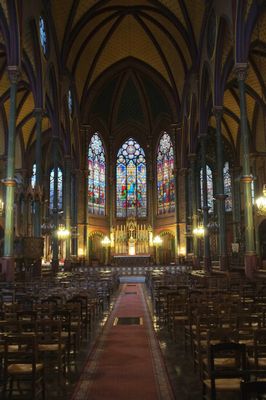
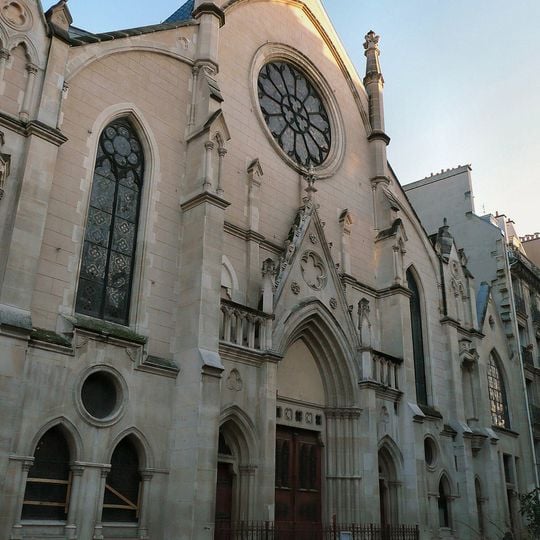
Église Saint-Eugène-Sainte-Cécile is a Gothic Revival church on rue Sainte-Cécile in Paris. Its light beige stone facade has a large rose window above a pointed-arch portal with dark wooden doors, flanked by tall pointed windows with quatrefoil tracery. Inside, slender cast-iron columns painted in blues, reds and greens support pointed arcades, and the vault ribs are forged iron.
This church was built between 1854 and 1855 by architects Louis-Auguste Boileau and Louis-Adrien Lusson as the first French church with a completely iron-framed structure. This construction method was revolutionary at the time and demonstrated how modern engineering could transform religious buildings.
In 1952 the parish priest, Canon Bony, asked Rome to add Saint Cecilia, patron saint of musicians, to the church's dedication because of the nearby Paris Conservatory. The building has no bell tower, so as not to disturb the musicians studying there. The double name Saint-Eugène-Sainte-Cécile has been in use since the mid-20th century.
The church stands at 6 rue Sainte-Cécile, on the corner with rue du Conservatoire, in the 9th arrondissement. Its main front faces rue Sainte-Cécile and the side wall faces rue du Conservatoire. Mass is celebrated daily in both forms of the Roman rite, and Sunday includes a traditional mass and a Solemn High Mass sung in Latin.
The church has no bell tower, deliberately omitted so that bells would not disturb musicians studying at the Paris Conservatory next door. The organ, by Joseph Merklin, had already been shown at the 1855 Exposition Universelle before its installation here. Jules Verne married Honorine Morel in this church on 10 January 1857.
The community of curious travelers
AroundUs brings together thousands of curated places, local tips, and hidden gems, enriched daily by 94,304 contributors worldwide.