Ganagobie Abbey, Romanesque abbey in Ganagobie, France
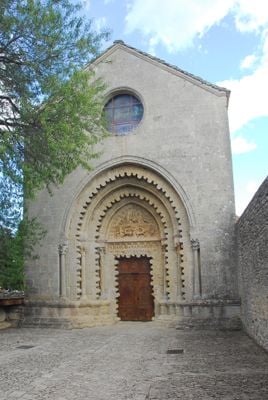
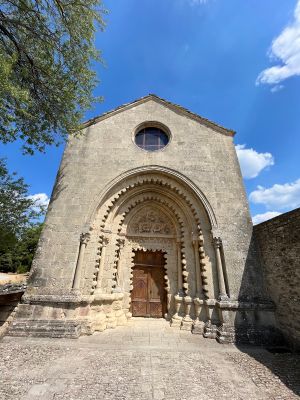
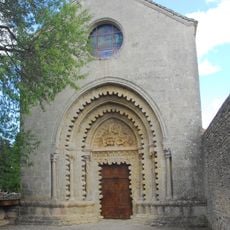
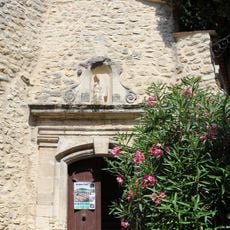
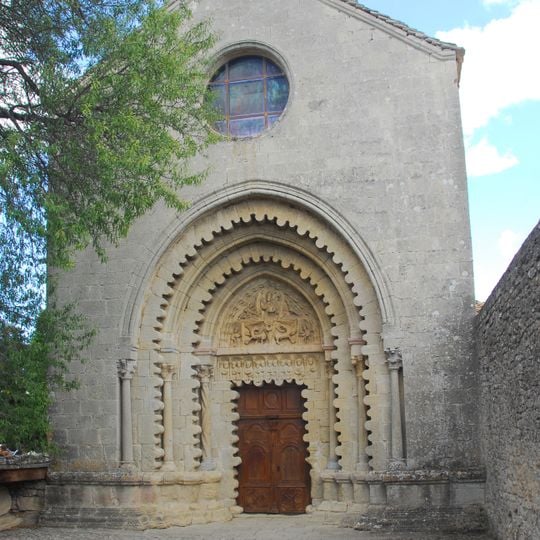
Ganagobie Abbey is a Benedictine monastery on a narrow plateau 350 metres above the Durance, about 15 km north-east of Forcalquier. Its Romanesque church, built in the first half of the 12th century, has a nave 17.7 metres long with three barrel-vaulted bays. The tall stone facade has a round window and a recessed portal with concentric rounded arches and carved capitals; inside, a carved tympanum sits above paired wooden doors.
A first monastery stood here in the 7th or 8th century; the house was refounded around 960–965 by Bishop John III of Sisteron and soon attached to Cluny, a possession confirmed by a bull of Pope Stephen IX on 6 March 1058. In 1562 the governor of Provence had the church vault and prior's lodging demolished to keep Huguenots from returning. In 1794 the district directory of Forcalquier pulled down the transepts, choir and eastern wing.
The monks sing Mass in Gregorian chant daily, while the Hours are sung in French with Latin hymns and antiphons. The community also makes essential-oil cosmetics and balms, including the "baume du pèlerin" sold at the abbey. The name Ganagobie may derive from an oronymic root referring to the height, or from a ruined tower.
The abbey stands on a narrow plateau 350 m above the Durance, reached by a paved road opened in 1953; the climb is steep and the site is exposed. The church, rebuilt between 1960 and 1975, holds the mosaics replaced in 1986, and the community asks visitors to respect the contemplative life of the roughly ten monks.
The medieval mosaics were rediscovered in 1898, but they stayed buried under earth until the church was rebuilt between 1960 and 1975; the restored choir mosaics were put back in place only in 1986. The floor, dated to 1120–1130, has no equivalent in France.
The community of curious travelers
AroundUs brings together thousands of curated places, local tips, and hidden gems, enriched daily by 94,061 contributors worldwide.