Fort du Salbert, Military fortress in Belfort, France
Fort du Salbert is a Séré de Rivières fort begun in 1874 and finished in 1877 on the summit of Salbert hill northwest of Belfort. Its entrance, set into a grassy embankment, has a round-arched light blue-green double door covered in black graffiti, framed by a pointed arch of reddish-brown stone blocks within a gray stone facade. A band above the arch carries "1674" on the left, "1877" on the right and a central plaque reading "FORT DU SALBERT"; the flanking walls show patches of exposed rubble masonry, and a paved path with green metal railings leads to the door.
Built between 1874 and 1877 as part of the second ring of Séré de Rivières forts around Belfort, Fort du Salbert was renamed Fort Lefebvre by decree in 1887 after General François Joseph Lefebvre. From 1893 it was linked to neighbouring forts by a strategic railway. German forces occupied it on 19 November 1944 until Commandos d'Afrique took it by surprise; Belfort was liberated on 22 November.
The fortress demonstrates how military engineers of the late 1800s designed defensive structures to control access through mountain passes. Walking through the complex shows the practical thinking behind each fortification's position and design.
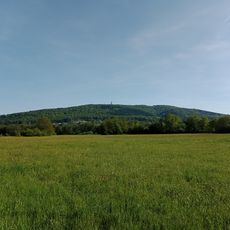
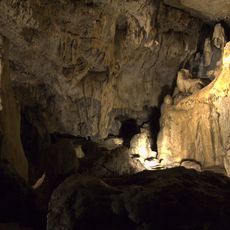
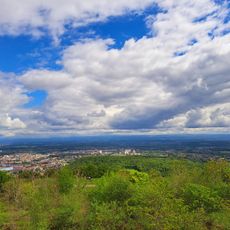
The fort sits at the summit of Salbert hill northwest of Belfort. The underground Ouvrage "G" section, used as a shelter from the 1950s, can be visited on a guided tour run by the preservation association created in 2016. The main fort never received the extensive concrete cover given to other Séré de Rivières forts.
The fort used an optical semaphore system to send messages rapidly between fortifications across the region, allowing military commanders to coordinate defenses in real time. This visual communication network was far faster than written dispatches sent by horse.
The community of curious travelers
AroundUs brings together thousands of curated places, local tips, and hidden gems, enriched daily by 93,856 contributors worldwide.