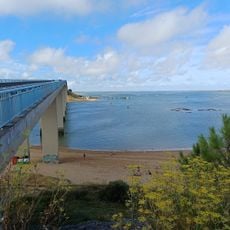
Passage du Gois, Submersible road in Vendée, France
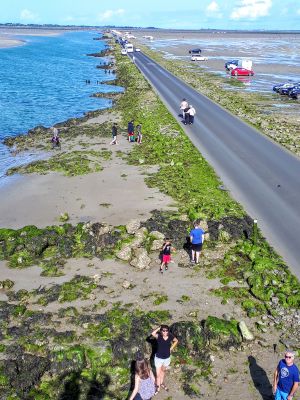
Passage du Gois is a causeway about 4 kilometers long connecting the mainland town of Beauvoir-sur-Mer to Noirmoutier Island. The roadway disappears beneath Atlantic tides twice daily and reappears when the water recedes.
The sandbank that makes the crossing possible formed about a thousand years ago where two opposing currents meet around Noirmoutier; it became walkable in the 18th century and stabilised in the 19th. The passage is first marked on a map in 1701, and the first wooden marker posts were set up in 1786. It was macadamised and marked every 100 metres in 1924, and listed as a monument historique on 11 July 1942.
The name Gois, recorded around 1577, derives from gué (ford). Since 1987 the Foulées du Gois foot race has started at the onset of the rising tide, with elite runners waiting until the water reaches their shoes. Two crosses mark the entry and exit of the crossing.
Nine rescue towers are spaced along the route and provide shelter if drivers are caught by rapidly rising water. Check the tide schedule before driving to ensure you travel during low tide periods when the road is safe.
The Passage du Gois is the starting point of the Foulées du Gois, an annual foot race run at the onset of low tide; professional athletes wait until the water is only as high as their shoes. In 1999 the causeway hosted a Tour de France stage where a crash on the slippery surface split the peloton by six minutes, ending the hopes of favourites including Alex Zülle, who finished second overall.
The community of curious travelers
AroundUs brings together thousands of curated places, local tips, and hidden gems, enriched daily by 93,396 contributors worldwide.