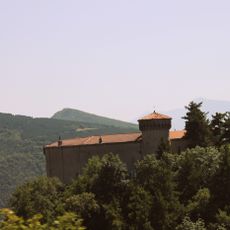
Abbaye de Léoncel, Cistercian abbey in Léoncel, France.
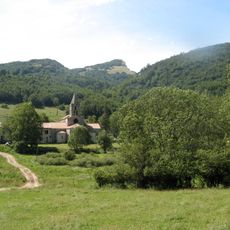
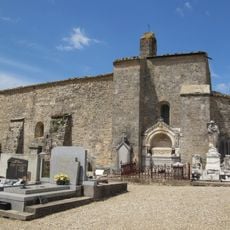
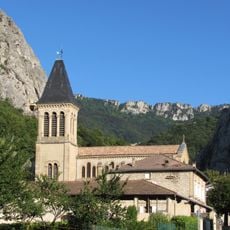
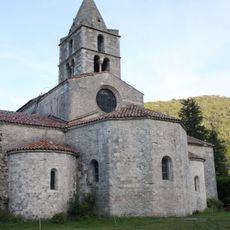
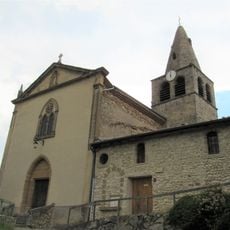
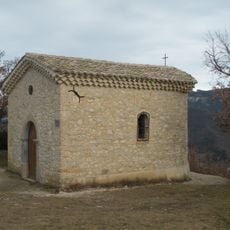
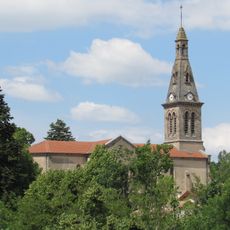
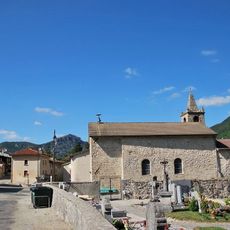
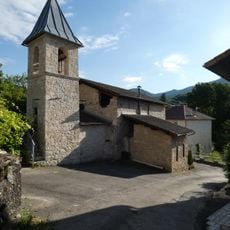
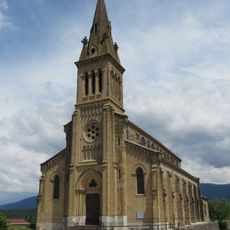
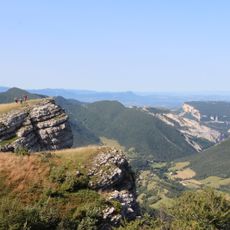
Abbaye de Léoncel is a former Cistercian abbey in the Vercors, at 912 m in the Petite Lyonne valley. Its cruciform church has a five-bay rib-vaulted nave, barrel-vaulted transept, a crossing crowned by a stone tower with pyramidal roof, and a chevet of a seven-sided central apse flanked by two half-round apses. The east wing of the cloister survives, with a twin window of the chapter house.
Founded in 1137 by monks from Bonnevaux Abbey, the monastery was united in 1194 with the community of La Part-Dieu near Romans-sur-Isère after land conflicts with the nearby Chartreuse of Bouvante were settled. This union allowed the monks to spend the harsher part of the year, from Saint Andrew's Day to Pentecost, on the more favourable plain. The church, begun in the mid-12th century and consecrated in 1188, was built in several campaigns up to about 1230. Raymond de Turenne ravaged the abbey in 1389–1390, leaving only the church standing; the cloister, except its eastern gallery, and the lay brothers' wing were never rebuilt. The community was suppressed in 1790 and the abbey church became the parish church.
The church became the parish church of Léoncel in 1790 and has been listed as a monument historique since 1840; the commune has owned it since 1854. In 2000 the artist Bernard Foucher made liturgical furnishings for it, including a wooden sculpture and a bronze Christ, the sacred vessels, the altar, the ambo and the credence lectern. Sister Marie-Françoise Giraud, a Dominican, settled in the abbey in 1974 and founded the association Les Amis de Léoncel that November; she died in December 2008 and is buried at Léoncel.
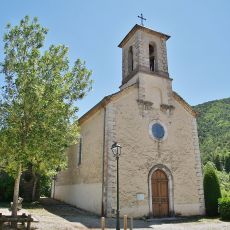
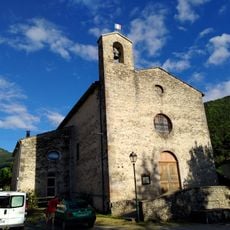
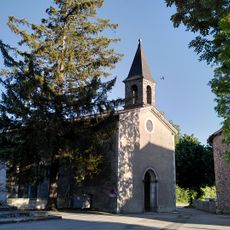
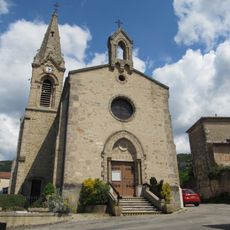
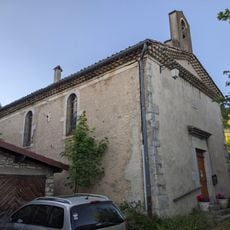
The church stands at 912 m in the Petite Lyonne valley, 37 km east of Valence; the abbey church has been the parish church since 1790 and belongs to the commune of Léoncel, created in 1854. The west facade has a central portal opened for parish services, with the side doors walled up. The east cloister wing survives, built into later structures, and keeps a twin window of the chapter house.
In 1194 the abbey was united with the community of La Part-Dieu near Romans-sur-Isère, after land conflicts with the nearby charterhouse of Bouvante were settled. The agreement let the monks spend the harsher part of the year, from Saint Andrew's Day to Pentecost, on the milder plain. The church's east wall of the nave holds a large oculus.
The community of curious travelers
AroundUs brings together thousands of curated places, local tips, and hidden gems, enriched daily by 94,365 contributors worldwide.