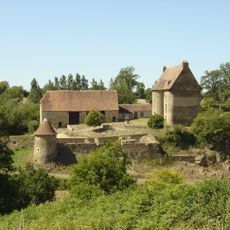
Abbaye de Prébenoît, Cistercian abbey in Bétête, France.
Abbaye de Prébenoît is a former Cistercian abbey in Bétête, Creuse, on the Petite Creuse. Of the church remain a 17th-century portal, the first bay of the north aisle and part of the north transept; the east and south wings of the convent building survive, partly restored. The long low stone building has a steep tiled roof, seven grilled upper windows and a central double door under a carved pediment.
The monastery was founded in 1140 when the abbey of Dalon received land through a donation from the lord of Malval. It remained in operation until the French Revolution, during which time it underwent various structural changes.
The name Prébenoît comes from the Latin Pratum Benedictum, "blessed meadow". The abbey was the burial place of the lords of Boussac: Roger de Brosse, who died in 1287, and his wife Marguerite de Déols were buried here, as was Jean de Brosse, the "maréchal de Boussac", who died in 1433. A visitor in 1788, Duval, described a bronze figure of Roger de Brosse in armour on a tomb slab about four inches thick, covered with a gilded copper plate painted with the arms of Brosse and Déols in medallions, some of which had been torn off.
The site was bought by the commune of Bétête around 1980 and entrusted to a support association, but in 2001 disputes led the commune to take it back. Access is not freely open, so arrange a visit in advance. The buildings stand on the bank of the Petite Creuse, about 33 km northeast of Guéret.
The abbey's church was shortened during the Hundred Years' War, when ditches were dug around the buildings and defence towers added. The first abbot, Pierre, is probably the founder; the monastery joined the Cistercian order in 1163.
The community of curious travelers
AroundUs brings together thousands of curated places, local tips, and hidden gems, enriched daily by 94,039 contributors worldwide.