Abbaye de Saint-Benoît-en-Woëvre, Gothic abbey in Vigneulles-lès-Hattonchâtel, France
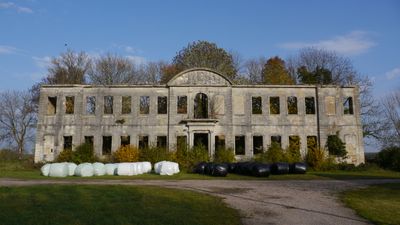
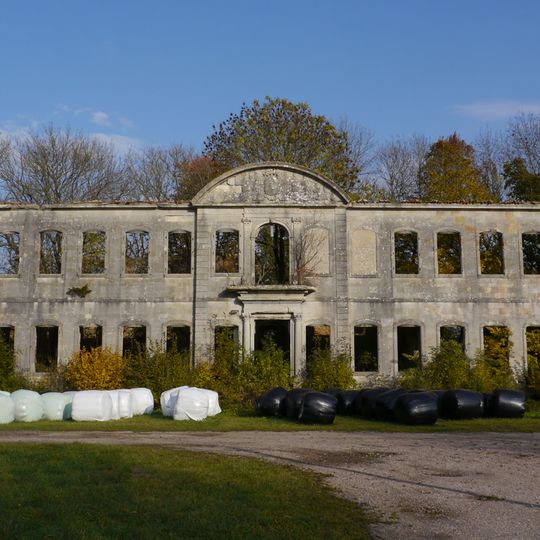
Abbaye de Saint-Benoît-en-Woëvre is a ruined stone building whose surviving west facade, rebuilt in the classical style between 1739 and 1754, stretches horizontally across the site. Its central section rises into a curved pediment above a tall arched opening, flanked by a smaller recessed doorway with a projecting stone frame. Two rows of rectangular window openings, all empty of glass, run along the facade, the upper row taller than the lower.
Founded in 1128 by Airard de Rinel and his wife on land in the forest of Richardménil, the house was Benedictine at first and became Cistercian in 1132 as a daughter of La Crête, in the line of Morimond. Judged unhealthy, the original site was abandoned: from 1739 to 1754 new buildings rose about 300 metres east, with A. Malbert designing the conventual buildings and J. Gautier the church. Dissolved in 1791, the church demolished in 1794, the abbey was destroyed in 1940 during the Battle of Saint-Mihiel, when it served as a German command post.
The monks dug the fish ponds that surround the site, turning existing marshes into managed water bodies and draining the land around them. The abbey also held granges, including Bouzonville, Hazavant, Champfontaine, Solry and Longeau, and built two refuge houses for wartime, at Thiaucourt and Lachaussée. Maps today still label the ruin "château ruiné".
The ruin stands at the crossroads of the D901 and D904, just beside Saint-Benoît-en-Woëvre and about six kilometres from Vigneulles-lès-Hattonchâtel. Only the two-storey 18th-century west facade survives, so the visit is an outdoor one: the empty window openings and the abbey coat of arms in the curved pediment are seen from the field side. The site lies in the Yron valley at about 228 m, near the Vigneulles and Belian ponds.
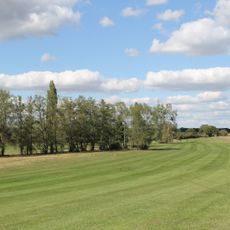
The surviving west facade carries the monastery coat of arms in its curved pediment, a detail visible from the field of wrapped bales in front. The 18th-century church, 50 metres long with 22 stalls and a dome, was demolished in 1794; its 16th-century main altar went to Saint-Étienne in Saint-Mihiel, and the two side altars to the church of Dampvitroux.
The community of curious travelers
AroundUs brings together thousands of curated places, local tips, and hidden gems, enriched daily by 95,295 contributors worldwide.