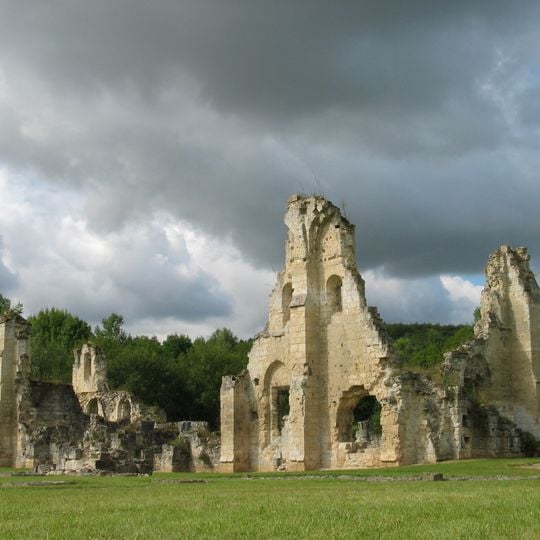
Vauclair Abbey, Cistercian monastery ruins in Bouconville-Vauclair, France
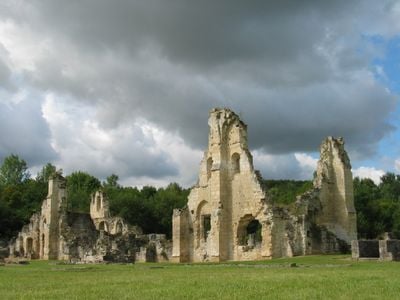
Vauclair Abbey is a ruined Cistercian monastery in Bouconville-Vauclair, in the Ailette valley at the foot of the northern side of the Chemin des Dames. Its surviving masonry, rebuilt in the 13th century, includes a tall central wall with a rounded arch opening near its top, a pointed opening and a rounded niche below it, and a lower wall to the right pierced by a large arched window. The weathered beige stone stands on a lawn; an arboretum of old apple and pear trees and a medicinal herb garden lie on the site.
Vauclair was founded in 1134 by Bernard of Clairvaux at the request of Barthélemy de Jur, bishop of Laon. On 23 May 1134, monks from Clairvaux led by the Englishman Henry Murdac, its first abbot, took possession; it was Clairvaux's 15th daughter house. It founded Le Reclus (1142) and La Charmoye (1167). Declared national property in the Revolution, it was sold in 1791 and turned into a farm; artillery fire destroyed almost all remaining buildings in 1917.
The name Vauclair comes from the Latin words Vallis clara, which represents a deliberate reversal of its mother house Clairvaux. This linguistic connection reflects the close relationship between this monastery and its parent order.
The ruins stand on a flat lawn in the Ailette valley, about 15 km south of Laon at the foot of the northern slope of the Chemin des Dames, in Bouconville-Vauclair. The medicinal garden of over 400 species, laid out by Father Courtois and the Ballot herborists and opened in 1976, and the arboretum of old northern French apple and pear trees at the entrance, opened in 1990, are both on site. The garden has been run by the association of the friends of Vauclair since 2006.
The 3,400 silver coins found on 3 August 1973, followed by more than 800 on 9 August, had been buried in two cloth bags. They were struck under rulers from Henry III to Louis XIV, including Henri II de Navarre and the Bishops of Liège Ernest and Ferdinand of Bavaria. Father René Courtois, who lived here from 1966 until his death in 2005, is buried at the centre of the church ruins.
The community of curious travelers
AroundUs brings together thousands of curated places, local tips, and hidden gems, enriched daily by 94,327 contributors worldwide.