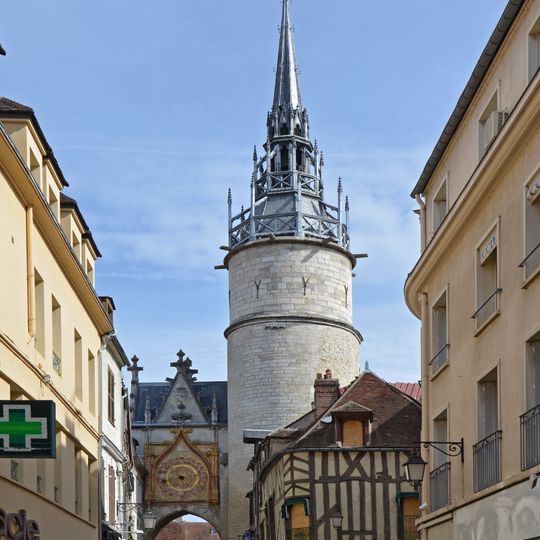
Clock tower of Auxerre, Medieval clock tower in central Auxerre, France
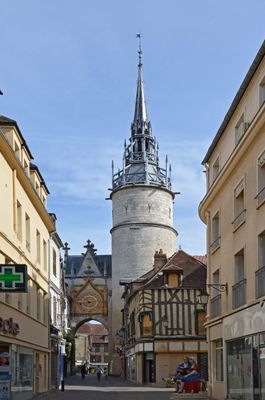
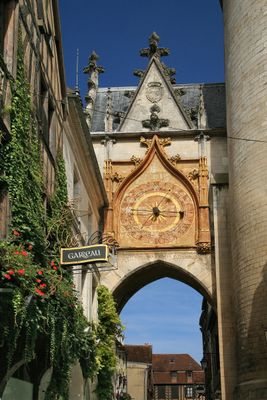
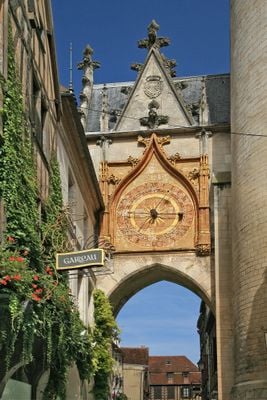
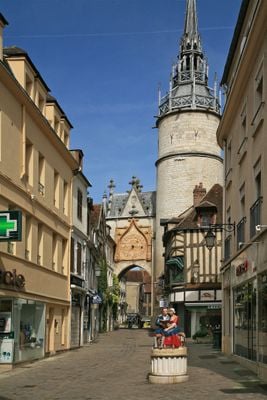
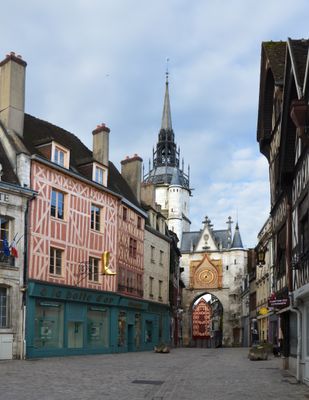
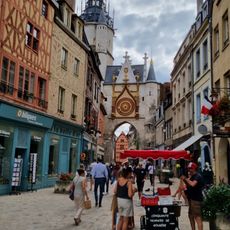
The Clock Tower of Auxerre is a 15th-century stone tower attached to the south-east side of the former Porte de Paris, slightly offset to the west. Its cylindrical shaft rises to an open belfry with vertical supports, topped by a slender slate-grey spire. Below, a gabled stone structure pierced by a pointed arch holds a circular clock with a golden dial and numerals, framed by a carved stone surround and a small pinnacle at the gable peak.
The tower occupies the site of the Roman-era Tour Gaillarde, part of the city's 3rd–4th century walls, which served as a prison until 1602. In 1457 Count Jean de Bourgogne authorised a belfry and clock on the tower and adjoining gate; after Charles VIII's permission in January 1483, work raised the tower and added a lead-clad timber spire. The clock was later fitted with a 1672 inscription on its north-east face.
The bells shaped daily life in the medieval city, calling people to prayer and marking the hours of work and rest. You can still sense this connection when standing in the square beneath the tower, surrounded by the same narrow streets where those sounds once echoed.
The tower can be viewed from the surrounding streets and squares, with no special equipment needed. The nearby tourist office has information about the building and can suggest walking routes through the historic center.
The clock mechanism uses two hands that move at different speeds, one tracking solar time and the other following lunar cycles. Few visitors notice this technical detail, yet it reveals the tower's original purpose to guide both religious and daily life.
The community of curious travelers
AroundUs brings together thousands of curated places, local tips, and hidden gems, enriched daily by 94,161 contributors worldwide.