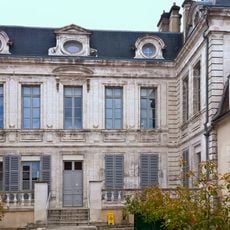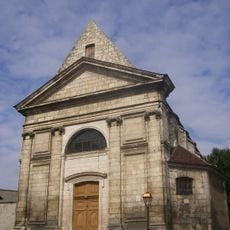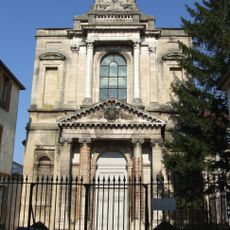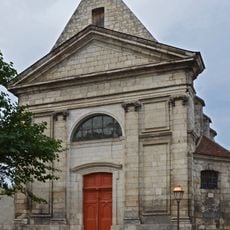
Palais épiscopal d'Auxerre, Episcopal palace in Auxerre, France
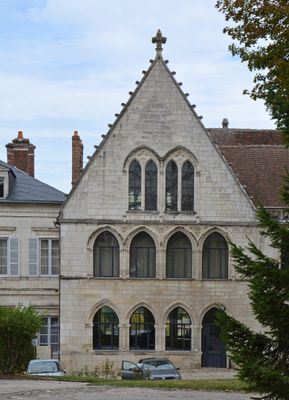
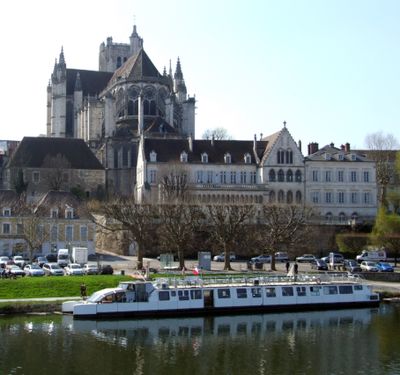
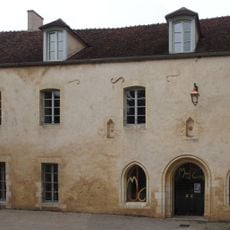
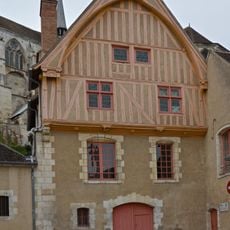
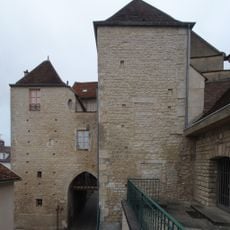
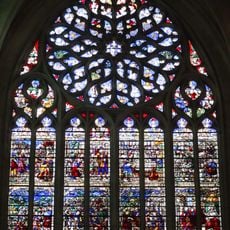
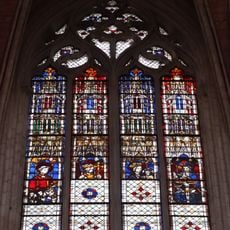
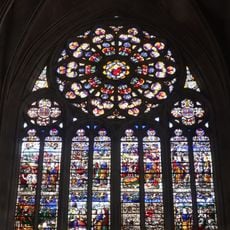
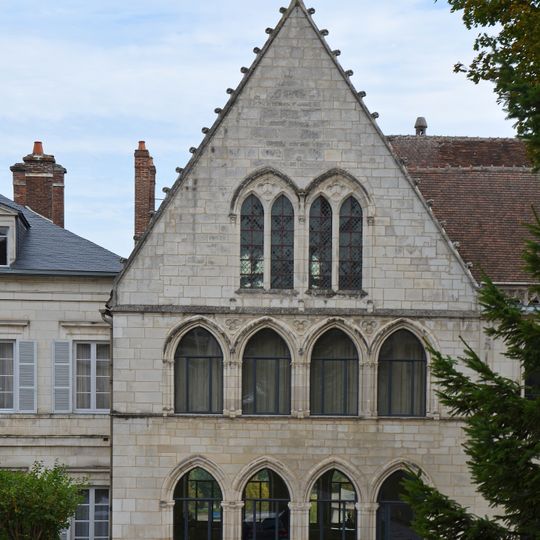
The Palais épiscopal d'Auxerre is an episcopal palace on the eastern edge of Auxerre's old town, inside the first ring of ramparts. Its oldest parts date from the 12th century. The synodal hall built by Guy de Mello (bishop 1247–1269) has a pointed gable with three tiers of openings: the top tier has two pairs of pointed, cusped windows divided by a central mullion and transoms; below are four wide pointed windows with plain vertical divisions, and the lowest tier has four similar openings with dark grilles and glass. The stone shows faint vertical joint lines and slight weathering.
The building was created in the 12th century as a residence for the bishops and underwent major reconstruction after a vault collapse in 1210. These rebuilding efforts shaped the structure visitors see today and reflect the construction changes that took place over time.
The Romanesque gallery east of the former refectory, now the prefect's office, was built under Bishop Hugues de Montaigu (1115–1136) as a walkway for bishops to oversee their vineyards on the Yonne slopes and collect toll revenues from the bridges. The term "episcopal palace" itself only dates from the 15th century, introduced by Bishop Pierre de Longueil (1449–1473); before that it was simply the bishop's house.
The building currently serves as administrative offices and is sometimes used for events, so access may be limited depending on activities taking place. Visitors should check ahead about which areas are accessible or if any work is underway.
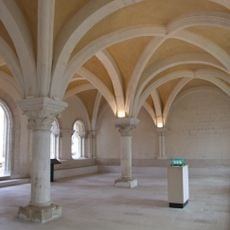
The wooden barrel vault of the synod hall, built under Guy de Mello (bishop 1247–1269), spans 20.76 m by 9 m, and the hall's upper windows, destroyed before 1743, once carried the coats of arms of the period.
The community of curious travelers
AroundUs brings together thousands of curated places, local tips, and hidden gems, enriched daily by 94,589 contributors worldwide.