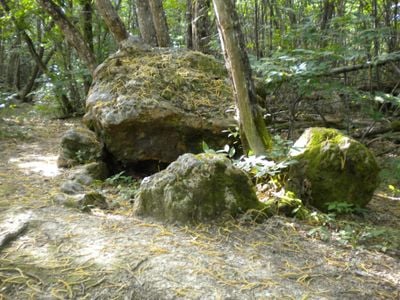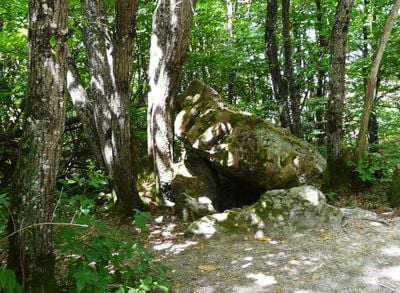
Peyre-Brune, Neolithic dolmen at Saint-Aquilin, France
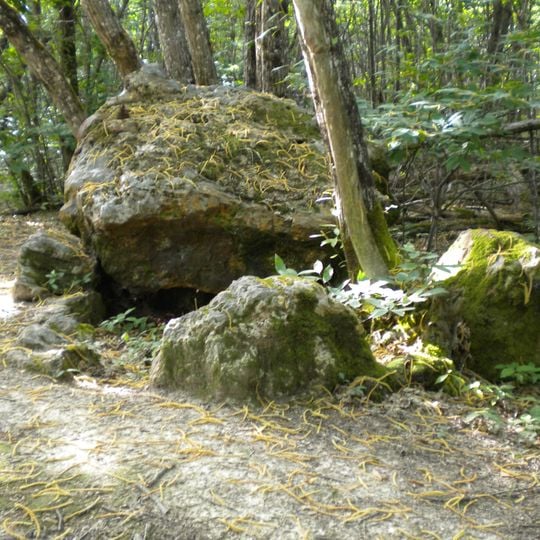
Peyre-Brune is a prehistoric megalithic monument near Saint-Aquilin with a rectangular burial chamber built from massive sandstone blocks in ochre tones. The structure consists of seven upright stone slabs and measures approximately 2.75 meters long and 2 meters wide.
Peyre-Brune was first mentioned by F. Jouannet in 1828. In 1874 the Société archéologique du Périgord excavated the chamber, finding a black flint axe, knives, arrowheads, three pendants of sandstone, flint and shell, and grey pottery typical of the Artenac culture; the finds are held in the Musée d'art et d'archéologie du Périgord in Périgueux. The dolmen was reused in the La Tène III period and classified as a monument historique in 1889.
The name comes from the Occitan peyre, meaning stone, and the French brune, brown, after the orange-brown sandstone of the slabs. The monument is also called Pierre-Brune, Peyrebrune, dolmen de Roque-Brune or dolmen de Belet. Local tradition holds that a fairy had six pages each carry a stone to build the tomb of her husband, a chieftain killed in battle, and cursed anyone who touched it.
The dolmen stands on the right side of the forest track from Seyssac to Segonzac, roughly 1.5 km after Seyssac, on a wooded ridge about 200 m above sea level. Access is on foot only, and the monument is increasingly overgrown by sweet chestnut, so expect uneven ground under trees.
Local tradition, recorded in the 1830 Calendrier de la Dordogne, holds that the grave is that of a military chief married to a fairy. She had six pages each carry a stone to build the dolmen where he fell in battle, and cursed anyone who dared touch the tomb.
The community of curious travelers
AroundUs brings together thousands of curated places, local tips, and hidden gems, enriched daily by 94,391 contributors worldwide.