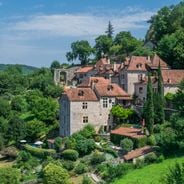
Château de Saissac, Medieval castle in Saissac, France.
Château de Saissac is a ruined fortress on a rocky promontory at the southern end of the village, above the Vernassonne ravine. It is built on three contiguous terraces and consists largely of schist, with granite used for some cornices. The remains include a polygonal keep about 20 metres high, two round towers flanking the south wall, and a 16th-century residence, the logis Aldonce, which now houses a small museum.
A castle is mentioned in texts as early as 960, when the bishop of Toulouse bequeathed it to the Count of Carcassonne. In the 11th century it passed to the Saissac lineage, vassals of the counts of Foix. During the Albigensian Crusade, Bouchard de Marly seized it; after 1234 Lambert de Thurey recovered it. Around 1300 it was rebuilt with royal engineers, and from 1331 to 1412 it belonged to the L'Isle-Jourdain family.
The castle gave its name to the Saissac lineage, a junior branch of the counts of Foix. In the 16th century the Bernuy family added large Renaissance mullioned windows, and the Aldonce residence was rebuilt with a ship's-hull roof frame. A small museum in these rooms displays the 2,000 13th-century deniers found at Saissac in 1979.
The site sits on a steep hillside, so comfortable shoes and care on uneven paths are recommended. To explore the interior rooms and cellars, advance notice or checking opening times is advisable.
The coin hoard of about 2,000 thirteenth-century deniers was found in 1979 during construction work in the village, not inside the castle itself. The finds are now displayed in the small museum installed in the Aldonce residence, the sixteenth-century logis rebuilt between 2004 and 2006 with a ship's-hull roof frame.
The community of curious travelers
AroundUs brings together thousands of curated places, local tips, and hidden gems, enriched daily by 94,158 contributors worldwide.