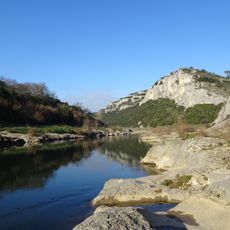
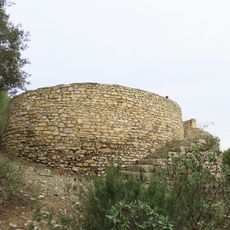
Saint-Nicolas-de-Campagnac Bridge, Medieval arch bridge in Sainte-Anastasie, France.
The Saint-Nicolas-de-Campagnac Bridge crosses the Gardon on five large semicircular arches plus smaller arches at each end, built of pale grey and tan stone. Its flat deck, edged by a low parapet on corbels, runs 120 metres and stands 18 metres above the river. A small stone building sits at one end and a square tower-like block at the other.
Built between 1245 and 1260, this structure established a vital passage between the towns of Nîmes and Uzès during the medieval period. Its construction marked a turning point in how people and goods could move through this region.
The bridge takes its name from the priory of Saint-Nicolas de Campagnac, first mentioned in a document of Louis VII addressed to the bishop of Uzès in 1156. Bishop Pons de Becmil pushed through the link between Nîmes and Uzès and was nicknamed "the bishop of the bridge". The D 979 still crosses it today.
Access is straightforward through the roads leading to Sainte-Anastasie, and the site is easy to visit while exploring the region. The bridge remains in active use for local traffic, so visitors should exercise caution when walking across it.
The bridge has not survived unchanged: its deck was raised in 1862, two arches were blown up by the retreating Wehrmacht on 24 August 1944, and the 9 September 2002 flood put the Gardon about three metres above the deck. A marble plaque set in the rock on the right bank marks that flood level.
The community of curious travelers
AroundUs brings together thousands of curated places, local tips, and hidden gems, enriched daily by 94,105 contributors worldwide.