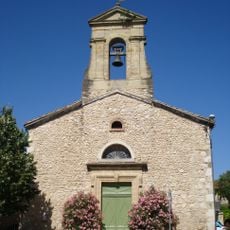
Gardon Gorges, Prehistoric cave with parietal art in Sainte-Anastasie, Gard, France
Baume-Latrone is a prehistoric cave in the commune of Sainte-Anastasie, Gard, whose deep network holds Upper Palaeolithic drawings made with fingers coated in brown clay. The figures, about 240 metres from the entrance, include mammoths, a large feline, a bear, a probable rhinoceros, a horse, two ibexes, two deer and a bovid, along with engraved lines and positive handprints.
Baume Latrone was excavated at its entrance porch in the late 19th century, revealing levels that were exclusively Neolithic. In 1940, after the cave was cleared, Upper Palaeolithic drawings were found in a deep network 240 metres from the entrance. It was classified as a Monument Historique on 19 May 1941, and a multidisciplinary team led by Marc Azéma resumed study in 2009.
The cave's name comes from "baume", the local word for cave (balma in Occitan). Its art was found in 1940 by schoolchildren from Nîmes, 240 metres inside the cave, and was made by smearing half-liquid brown clay with two to four fingertips, a technique found nowhere else in Palaeolithic art.
The cave lies in the commune of Sainte-Anastasie, in the Gard, and its decorated network begins about 240 metres from the entrance, so the painted panels are reached only by going deep inside. Access is reserved for guided or authorised visits; the original drawings are not open to casual entry.
The cave art was found in 1940 by schoolchildren from Nîmes, 240 metres inside the cave, after a passage was cleared. The figures were drawn with brown clay using two to four fingertips, a technique called polydigital that is not known elsewhere in Palaeolithic cave art.
The community of curious travelers
AroundUs brings together thousands of curated places, local tips, and hidden gems, enriched daily by 93,483 contributors worldwide.